A Levels Physics (9702)•9702/12/M/J/19
A Levels Physics (9702) — 9702/12/M/J/19, Question 18
A bungee jumper jumps off a high bridge, when attached to it by a long elastic rope which obeys Hooke's law. The gravitational potential energy of the jumper is measured relative to the lowest point reached by the jumper. Which graph shows the variation of the gravitational potential energy of the jumper, and the elastic potential energy in the rope, with the vertical distance fallen from the top of the bridge?
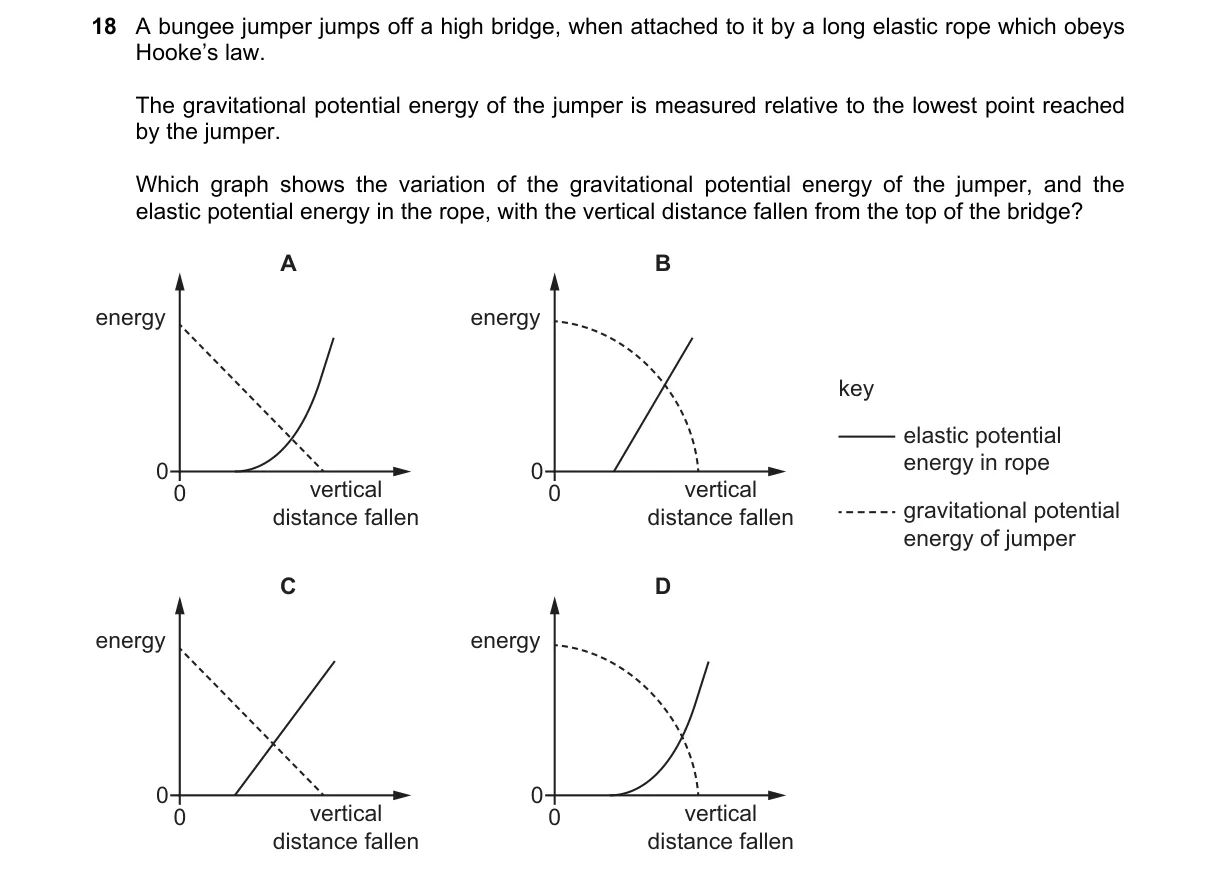
Answer choices
- AOption A
- BOption B
- COption C
- DOption D
Explanation
Energy conservation in bungee jumping
Steps:
- Gravitational PE is zero at lowest point, so at distance fallen x (0 to h), it equals mg(h - x), decreasing linearly from mgh to 0.
- Elastic PE is zero until rope stretches; then (1/2)k(y)^2 where y = x - L (L = unstretched length), increasing quadratically with extension.
- Total mechanical energy conserved: initial gravitational PE converts to elastic PE at lowest point.
- Graph vs. x shows linear gravitational decrease and quadratic elastic rise, meeting at x = h.
Why A is correct:
- Matches definitions: gravitational PE linear in height (PE = mgh), elastic PE quadratic per Hooke's law (PE = ½kx²).
Why the others are wrong:
- B: Elastic PE shown linear, violating Hooke's law quadratic dependence.
- C: Gravitational PE curved, ignoring linear relation to height.
- D: Energies don't sum to constant total, breaking conservation.
Final answer: A
Topic: Gravitational potential energy and kinetic energy
Practice more A Levels Physics (9702) questions on mMCQ.me