A Levels Physics (9702)•9702/11/M/J/19
A Levels Physics (9702) — 9702/11/M/J/19, Question 5
The speed shown on a car's speedometer is proportional to the rate of rotation of its wheels. A car has new tyres of diameter 600mm. The speedometer is accurately calibrated for this diameter. The tyres wear shown, with 6mm of material being removed from the outer surface. What is the error in the speed shown on the speedometer after this wear has taken place?
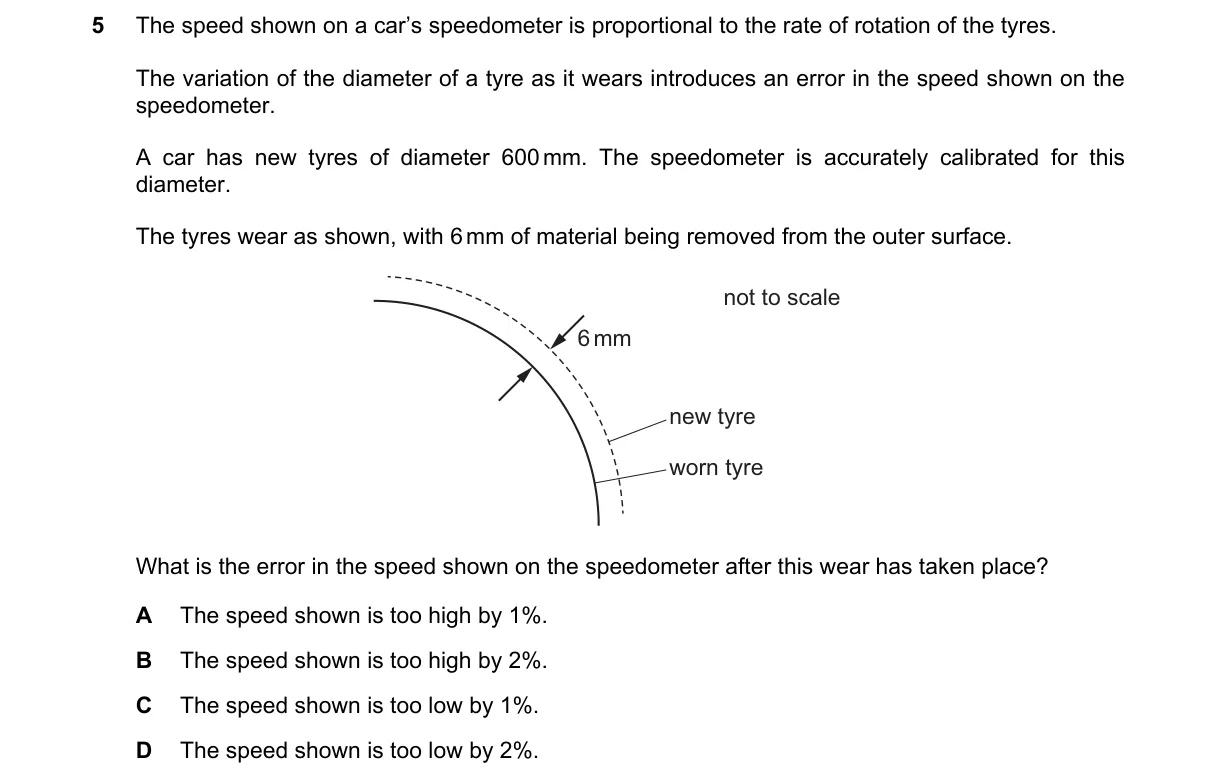
Answer choices
- AThe speed shown is too high by 1%.
- BThe speed shown is too high by 2%.
- CThe speed shown is too low by 1%.
- DThe speed shown is too low by 2%.
Explanation
Tire wear reduces effective rolling diameter, overestimating speed
Steps:
- Original tire diameter is 600 mm, so circumference is π × 600 mm.
- 6 mm wear on outer surface reduces radius by 6 mm, decreasing diameter by 12 mm to 588 mm.
- New circumference is π × 588 mm.
- Speedometer uses original circumference; for same rotation rate, shown speed = actual speed × (600/588) ≈ 1.02 (2% higher).
Why B is correct:
- Speed is proportional to wheel rotation rate times circumference; smaller actual circumference means shown speed exceeds true speed by (original diameter - new diameter)/new diameter = 12/588 ≈ 2%.
Why the others are wrong:
- A: Error is 2%, not 1%.
- C: Speed shown is too high, not low.
- D: Speed shown is too high, not low, and error is 2%, not 1%.
Final answer: B
Topic: Kinematics of uniform circular motion
Practice more A Levels Physics (9702) questions on mMCQ.me