A Levels Physics (9702)•9702/11/M/J/19
A Levels Physics (9702) — 9702/11/M/J/19, Question 40
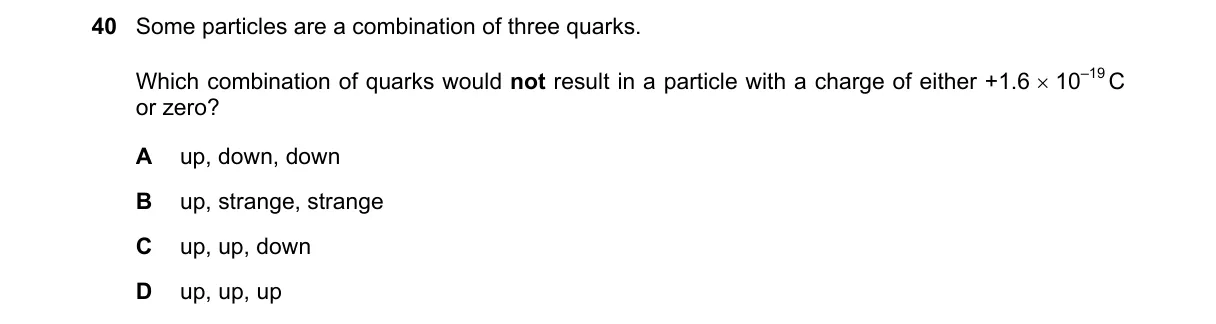
Which combination of quarks would not result in a particle with a charge of either +1.6 × 10^{-19} C
Answer choices
- Aup, down, down
- Bup, strange, strange
- Cup, up, down
- Dup, up, up
Explanation
Quark charges determine baryon electric charge
Steps:
- Up quark charge: +2/3 e; down and strange: -1/3 e (e = 1.6 × 10^{-19} C).
- Baryon charge = sum of three quark charges.
- Proton charge = +1 e; calculate each option's total.
- Identify combination not equaling +1 e.
Why D is correct:
- Three up quarks: +2/3 e + 2/3 e + 2/3 e = +2 e (delta++ baryon, charge +2 e by quark model).
Why the others are wrong:
- A: Up + down + down = +2/3 -1/3 -1/3 = 0 e (neutron).
- B: Up + strange + strange = +2/3 -1/3 -1/3 = 0 e (neutral hyperon).
- C: Up + up + down = +2/3 +2/3 -1/3 = +1 e (proton).
Final answer: D
Topic: Fundamental particles
Practice more A Levels Physics (9702) questions on mMCQ.me