A Levels Physics (9702)•9702/11/M/J/19
A Levels Physics (9702) — 9702/11/M/J/19, Question 35
When a battery is connected to a resistor, the battery gradually becomes warm. This causes the internal resistance of the battery to increase whilst electromotive force (e.m.f.) stays unchanged. As the internal resistance of the battery increases, how do the terminal potential difference and output power change?
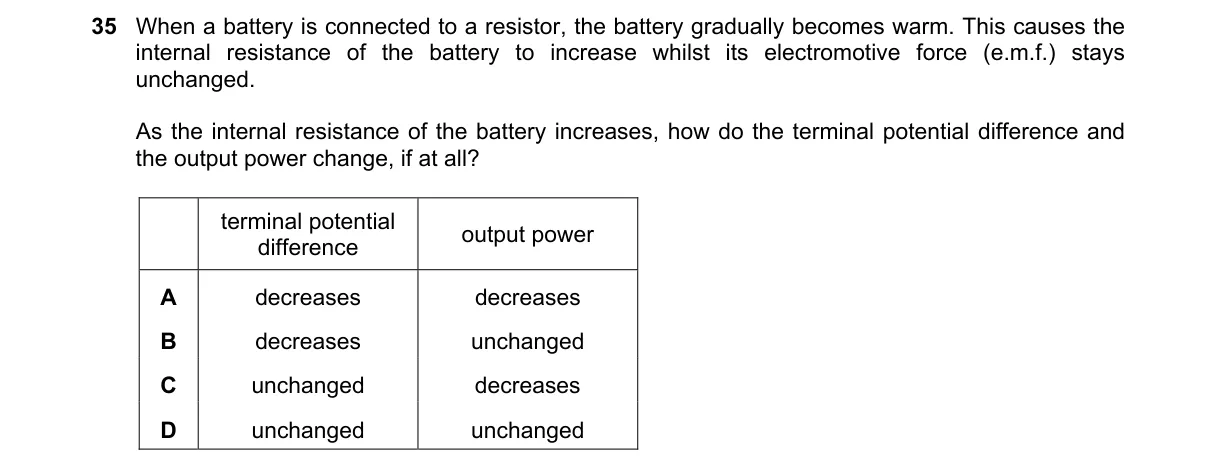
Answer choices
- Aterminal potential difference decreases, output power decreases
- Bterminal potential difference decreases, output power unchanged
- Cterminal potential difference unchanged, output power unchanged
- Dterminal potential difference unchanged, output power decreases
Explanation
Impact of Rising Internal Resistance on Voltage and Power
Steps:
- Terminal potential difference V = E × (R / (R + r)), where E is e.m.f., R is external resistance, r is internal resistance; as r increases, V decreases.
- Current I = E / (R + r); as r increases, I decreases.
- Output power P = I²R; as I decreases, P decreases.
Why A is correct:
- Formulas V = E × R/(R + r) and P = [E/(R + r)]² × R show both V and P decrease as r increases, per Ohm's law for circuits with internal resistance.
Why the others are wrong:
- B: Output power decreases, not unchanged, since P depends on I which falls.
- C: Both terminal potential difference and output power decrease, not unchanged.
- D: Terminal potential difference decreases, not unchanged, as V = IR with I dropping.
Final answer: A
Topic: Practical circuits
Practice more A Levels Physics (9702) questions on mMCQ.me