A Levels Physics (9702)•9702/11/M/J/19
A Levels Physics (9702) — 9702/11/M/J/19, Question 33
A voltmeter connected between two points P and Q in an electrical circuit shows a reading of 1V. Which statement is correct?
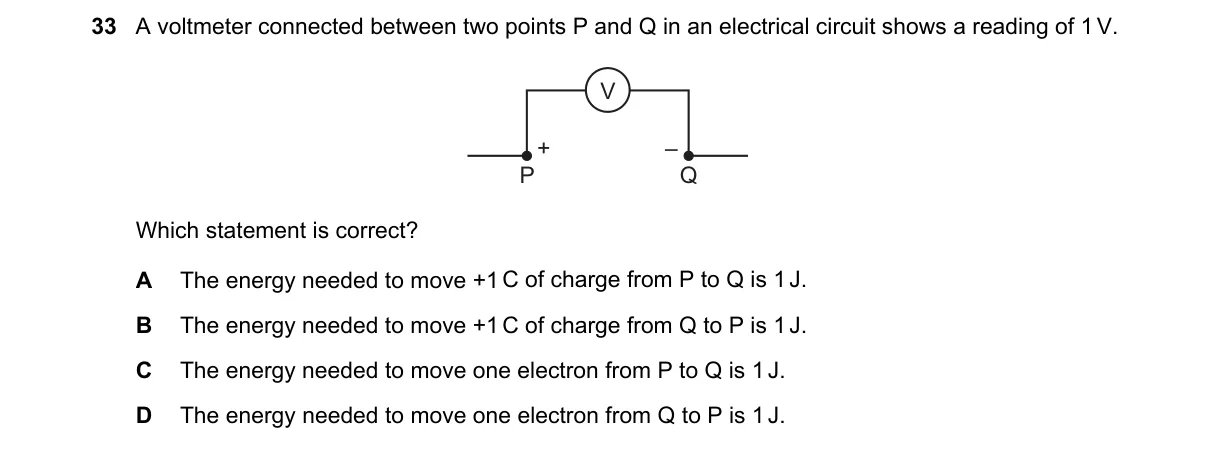
Answer choices
- AThe energy needed to move +1C of charge from P to Q is 1J.
- BThe energy needed to move +1C of charge from Q to P is 1J.
- CThe energy needed to move one electron from P to Q is 1J.
- DThe energy needed to move one electron from Q to P is 1J.
Explanation
Voltage as potential difference and work per unit charge
Steps:
- Voltmeter reads 1V, indicating potential at P is 1V higher than at Q.
- Potential difference V equals work done W per unit positive charge q moved from lower to higher potential: V = W/q.
- For +1C charge, q = +1C, so W = V × q = 1V × 1C = 1J.
- Direction from Q (lower potential) to P (higher potential) requires 1J input energy.
Why B is correct:
- Definition of electric potential difference: V = W/q for positive charge moved from lower to higher potential point.
Why the others are wrong:
- A: Moving +1C from P (higher) to Q (lower) releases 1J, so energy needed is -1J (or 0 input).
- C: Electron has charge -1.6×10^{-19}C; energy for one from P to Q is tiny (-1.6×10^{-19}J), not 1J.
- D: For electron from Q to P, direction aligns with field for negative charge, releasing energy, not requiring 1J.
Final answer: B
Topic: Potential difference and power
Practice more A Levels Physics (9702) questions on mMCQ.me