A Levels Physics (9702)•9702/11/M/J/19
A Levels Physics (9702) — 9702/11/M/J/19, Question 3
A particle has velocity V at an angle θ to the horizontal. The components of the particle's velocity are V_y in the vertical direction and V_x to the right in the horizontal direction, as shown. What are expressions for the magnitude of V and for the angle θ?
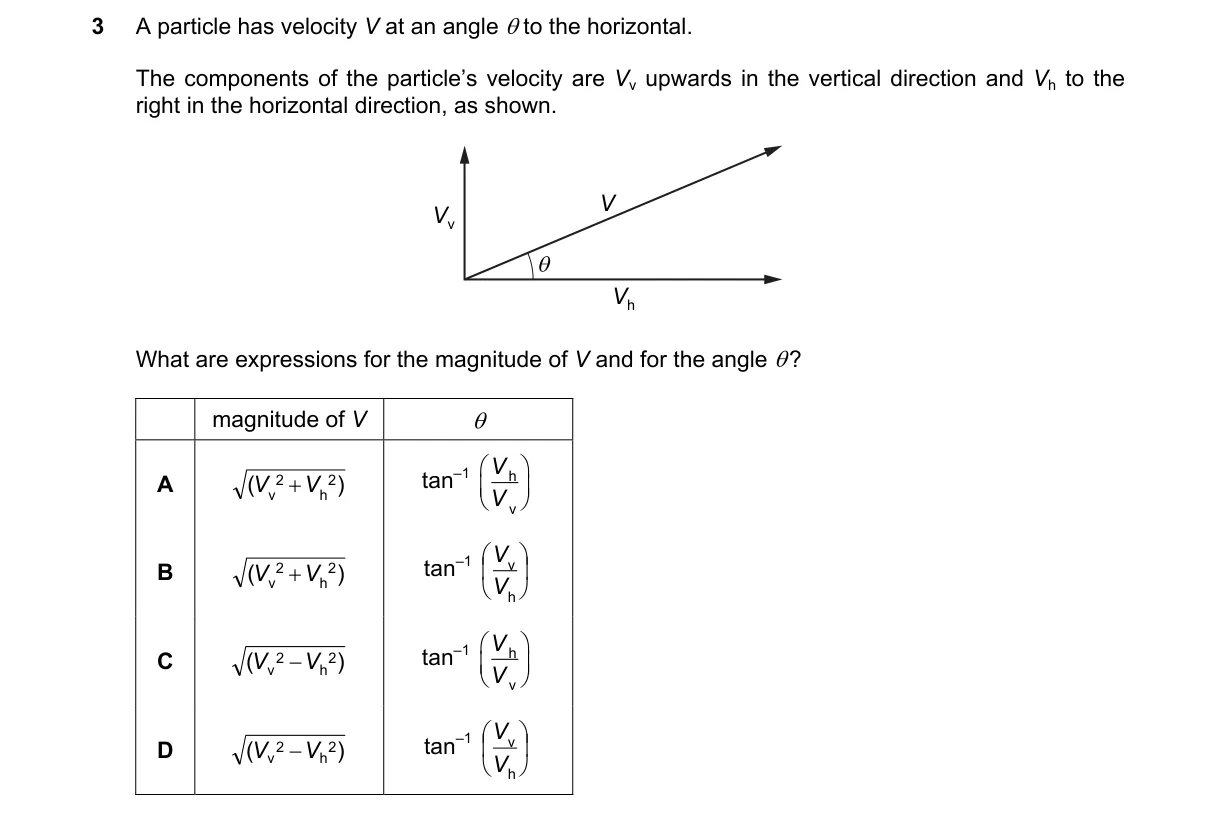
Answer choices
- A\sqrt{V_x^2 + V_y^2}, \tan^{-1}(V_y / V_x)
- B\sqrt{V_x^2 + V_y^2}, \tan^{-1}(V_x / V_y)
- C\sqrt{V_x^2 - V_y^2}, \tan^{-1}(V_y / V_x)
- D\sqrt{V_x^2 - V_y^2}, \tan^{-1}(V_x / V_y)
Explanation
Velocity Components and Angle Steps:
- The velocity V forms a right triangle with horizontal component V_x and vertical component V_y.
- Magnitude V is the hypotenuse: V = √(V_x² + V_y²) by Pythagorean theorem.
- Angle θ to horizontal satisfies tanθ = opposite/adjacent = V_y / V_x.
- Thus, θ = tan⁻¹(V_y / V_x), matching option A.
Why A is correct:
- It uses Pythagorean theorem for vector magnitude and tangent definition for angle from horizontal.
Why the others are wrong:
- B: Magnitude correct, but tan⁻¹(V_x / V_y) gives angle to vertical, not horizontal.
- C: √(V_x² - V_y²) subtracts components, invalid for magnitude.
- D: Subtraction for magnitude is wrong, and tan⁻¹(V_x / V_y) is angle to vertical.
Final answer: A
Topic: Scalars and vectors
Practice more A Levels Physics (9702) questions on mMCQ.me