A Levels Physics (9702)•9702/11/M/J/19
A Levels Physics (9702) — 9702/11/M/J/19, Question 21
0.5 m length of steel wire and 1 m length of brass are joined together. The combined wires are suspended from a fixed support and a force of 40 N is applied, as shown. The Young's modulus of steel is 2.0 × 10^11 Pa. The Young's modulus of brass is 1.0 × 10^10 Pa. Each wire has a cross-sectional area of 2 × 10^-6 m². The wires obey Hooke's law. What is the total extension of the wires.
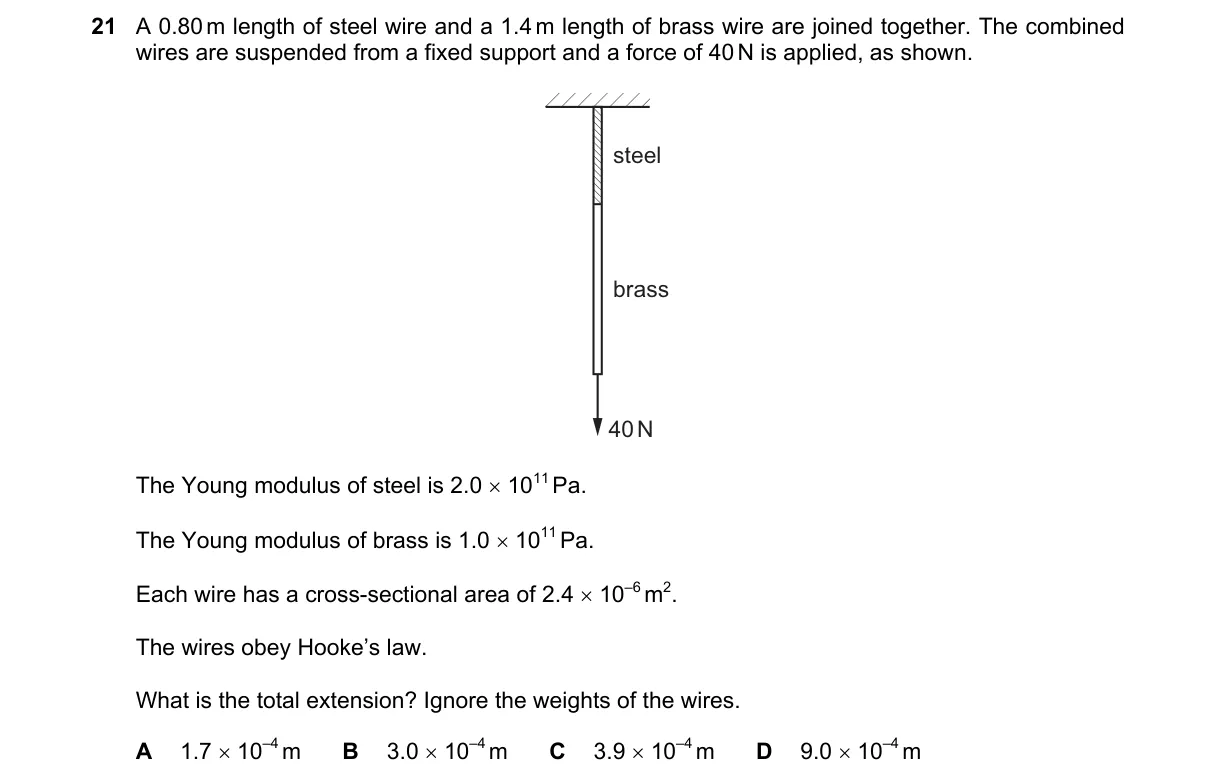
Answer choices
- A7 × 10^{-4} m
- B3 × 10^{-4} m
- C9 × 10^{-4} m
- D0 × 10^{-4} m
Explanation
Wires in series: same force, total extension sums individual δ = FL/(AY) Steps:
- δ_steel = (40 N × 0.5 m) / (2×10^{-6} m² × 2.0×10^{11} Pa) = 20 / 4×10^5 = 5×10^{-5} m
- δ_brass = (40 N × 1 m) / (2×10^{-6} m² × 1.0×10^{11} Pa) = 40 / 2×10^5 = 2×10^{-4} m
- Total δ = 5×10^{-5} m + 2×10^{-4} m = 2.5×10^{-4} m ≈ 3×10^{-4} m Why B is correct:
- Hooke's law gives extension δ = FL/(AY); for series wires, same F and A, total δ sums δ_steel and δ_brass to ≈3×10^{-4} m Why the others are wrong:
- A overestimates by using lower Y_brass (e.g., 10^{10} Pa), yielding larger δ_brass ≈2×10^{-3} m
- C adds unrelated values or misapplies lengths, exceeding calculated total
- D ignores extension, violating Hooke's law for elastic wires under force
Final answer: B
Topic: Stress and strain
Practice more A Levels Physics (9702) questions on mMCQ.me