A Levels Physics (9702)•9702/11/M/J/19
A Levels Physics (9702) — 9702/11/M/J/19, Question 15
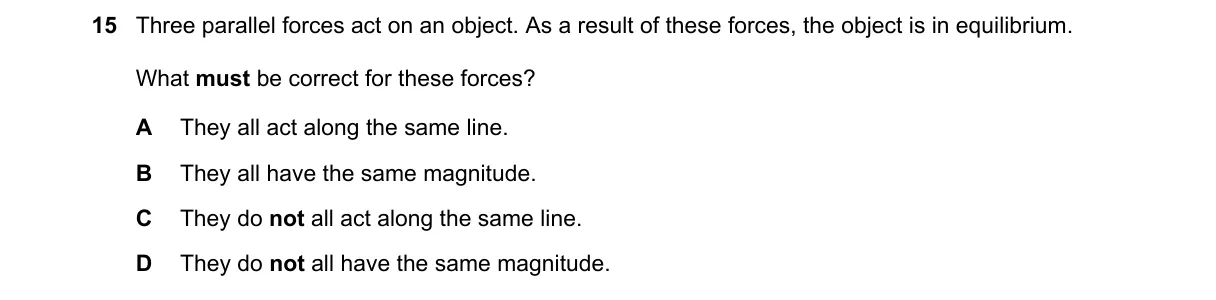
Three parallel forces act on an object. As a result of these forces, the object is in equilibrium. What must be correct for these forces?
Answer choices
- AThey all act along the same line.
- BThey all have the same magnitude.
- CThey do not all act along the same line.
- DThey do not all have the same magnitude.
Explanation
Parallel forces in equilibrium require unequal magnitudes for an odd number
Steps:
- Equilibrium demands zero net force (translational) and zero net torque (rotational).
- For parallel forces, net force is the algebraic sum considering directions.
- Three equal-magnitude forces cannot sum to zero, as an odd number prevents equal opposition (e.g., two in one direction, one in opposite requires different magnitudes).
- Different magnitudes allow sum to zero; positions ensure torque balance if not collinear.
Why D is correct:
- Newton's first law requires net force = 0; equal magnitudes for three parallel forces violate this, as vectors cannot cancel evenly (odd count).
Why the others are wrong:
- A: Collinear action is possible with unequal magnitudes but not required; non-collinear setups work if torques balance.
- B: Equal magnitudes prevent net force = 0 for three forces, making equilibrium impossible.
- C: Non-collinear action is unnecessary; collinear forces equilibrate if magnitudes sum to zero.
Final answer: D
Topic: Equilibrium of forces
Practice more A Levels Physics (9702) questions on mMCQ.me