A Levels Physics (9702)•9702/13/M/J/18
A Levels Physics (9702) — 9702/13/M/J/18, Question 7
Two masses, M and m, are connected by an inextensible string which passes over a frictionless pulley. Mass M rests on a frictionless slope, shown. The slope is at an angle θ to the horizontal. The two masses are initially held stationary and then released. Mass M moves down the slope. Which expression must be correct?
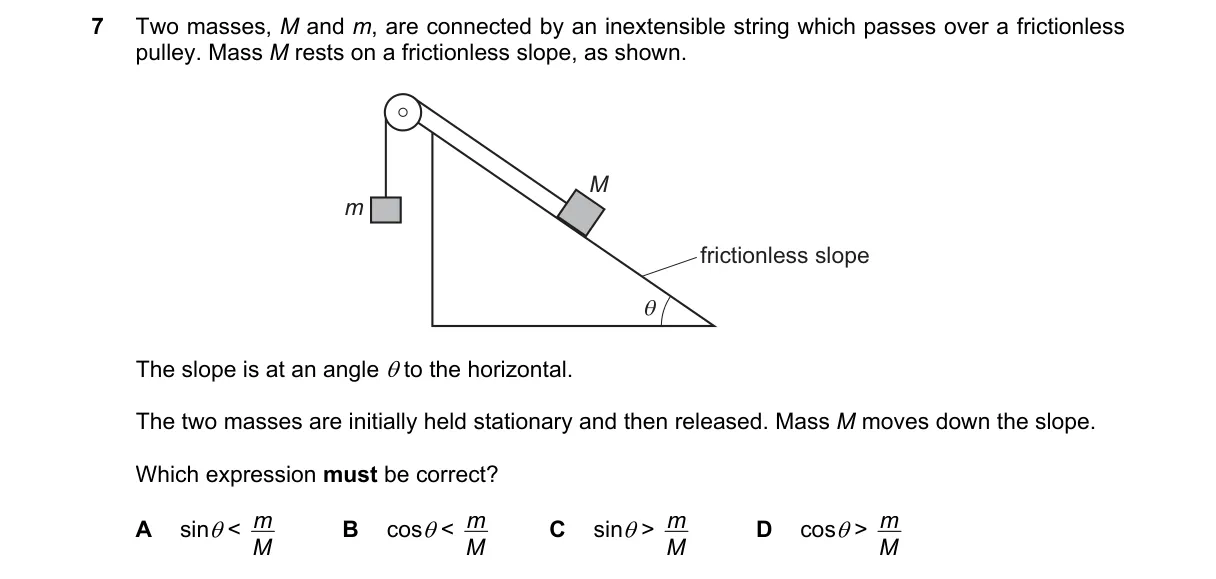
Answer choices
- Asinθ = m/M
- Bcosθ = m/M
- Csinθ = M/m
- Dcosθ > M/m
Explanation
Critical angle for slope mass descending Steps:
- Component of gravity pulling slope mass m down incline: m g sinθ.
- Tension from hanging mass M equals M g at equilibrium (a=0).
- Set forces equal for limiting case: m g sinθ = M g.
- Solve for angle: sinθ = M/m.
Why C is correct:
- Newton's second law at equilibrium requires parallel component of slope mass weight to balance hanging mass weight, yielding sinθ = M/m as critical condition; above this θ, slope mass accelerates down.
Why the others are wrong:
- A: Reverses mass roles, giving condition for hanging mass descending.
- B: cosθ relates to normal force, irrelevant to along-slope motion.
- D: Inequality involves perpendicular component, not determining descent direction.
Final answer: C
Topic: Momentum and Newton's laws of motion
Practice more A Levels Physics (9702) questions on mMCQ.me