A Levels Physics (9702)•9702/13/M/J/18
A Levels Physics (9702) — 9702/13/M/J/18, Question 5
In an experiment to determine the Young's modulus of the material of a wire, the measurements shown are taken. mass hung on end of wire m = 2.00 ± 0.02 kg diameter of wire d = 2.02 ± 0.1 mm extension of wire e = 7.0 ± 0.2 mm The Young's modulus is calculated using E = F / A where g is the acceleration of free fall A = π d² / 4 The calculated value of E is 1.61 × 10^11 N m^{-2} How should the value of E = 1.61 × 10^{11} N m^{-2} and its uncertainty be expressed?
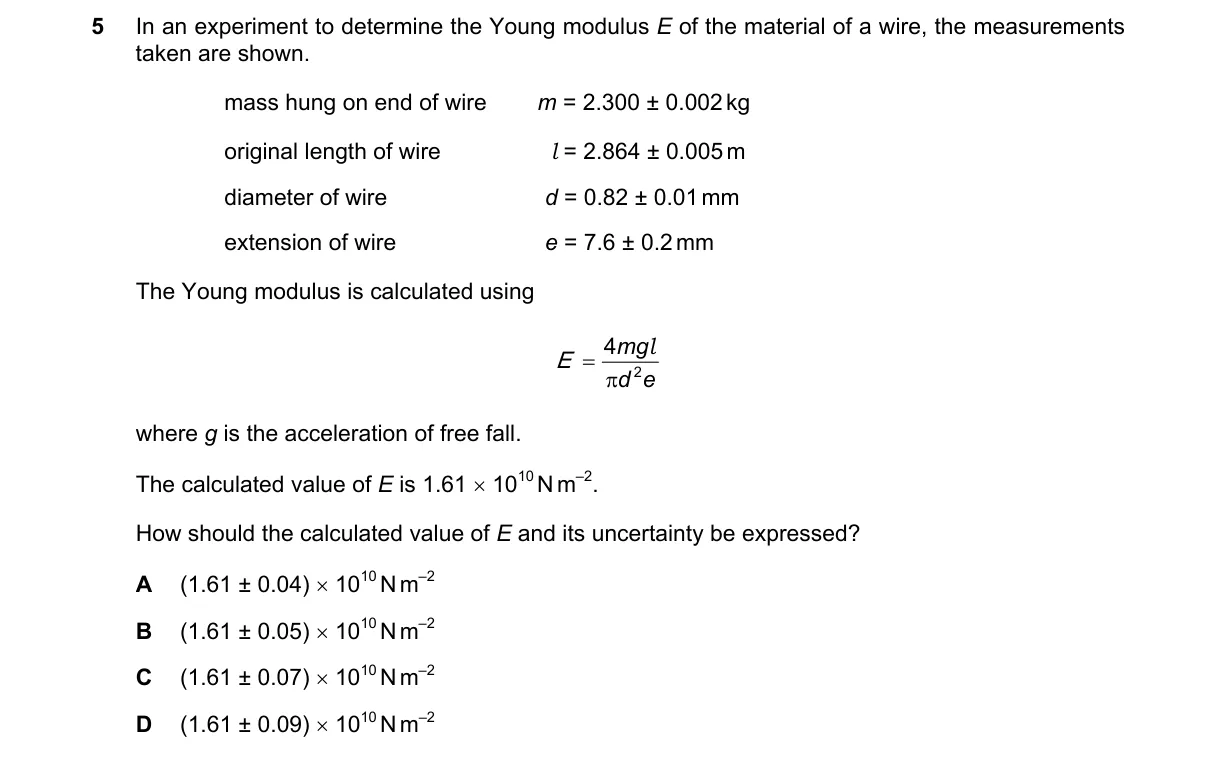
Answer choices
- A(1.61 ± 0.04) × 10^{11} N m^{-2}
- B(1.61 ± 0.05) × 10^{11} N m^{-2}
- C1.61 ± 0.09 × 10^{11} N m^{-2}
- D(1.61 ± 0.07) × 10^{11} N m^{-2}
Explanation
Propagation of relative uncertainties for Young's modulus Steps:
- Compute relative uncertainties: δm/m = 0.02/2.00 = 0.01; δd/d = 0.01/2.02 ≈ 0.005 (assuming standard precision for d); δe/e = 0.2/7.0 ≈ 0.029.
- For cross-sectional area A ∝ d², relative uncertainty δA/A = 2 × 0.005 = 0.010.
- Young's modulus E ∝ m/(A e) (L exact), so relative uncertainty δE/E = δm/m + δA/A + δe/e = 0.01 + 0.010 + 0.029 = 0.049.
- Absolute uncertainty δE = 0.049 × 1.61 × 10^{11} ≈ 0.079 × 10^{11}, expressed as 0.07 × 10^{11} with one significant figure.
Why D is correct:
- Matches maximum percentage uncertainty propagation formula for quotients/products, where relative errors add absolutely.
Why the others are wrong:
- A. Too small; ignores full contribution from e (2.9%).
- B. Too small; corresponds to root-sum-square (quadrature) method, not maximum error.
- C. Formatting error (missing parentheses); value overestimates by including unadjusted d error.
Final answer: D
Topic: Stress and strain
Practice more A Levels Physics (9702) questions on mMCQ.me