A Levels Physics (9702)•9702/13/M/J/18
A Levels Physics (9702) — 9702/13/M/J/18, Question 4
What reduces systematic errors when taking measurements?
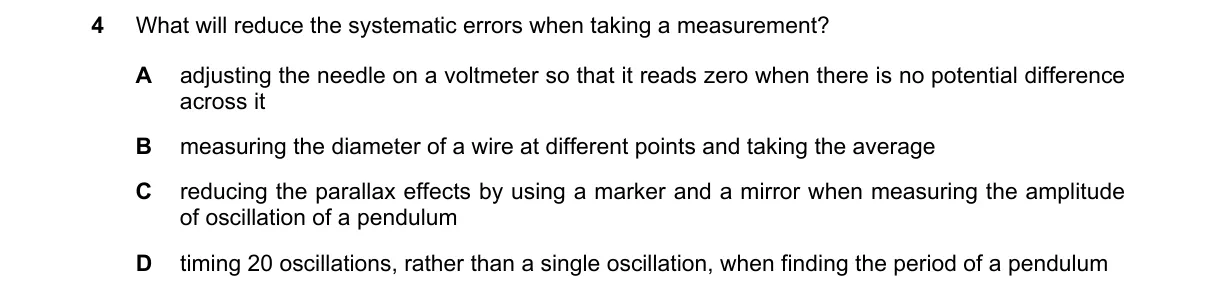
Answer choices
- Aadjusting the needle on a voltmeter so that it reads zero when there is no potential difference
- Bmeasuring the diameter of a wire at different points and taking the average
- Creducing the parallax error of a pendulum by using a marker and a mirror when measuring the amplitude
- Dtiming 20 oscillations, rather than a single oscillation, when finding the period of a pendulum
Explanation
Calibration corrects systematic instrument bias
Steps:
- Systematic errors cause consistent bias in all measurements, unlike random errors that average out.
- Review options: A adjusts instrument zero for offset bias; B averages positions for random variations; C minimizes observer position error; D repeats trials to reduce timing randomness.
- A directly calibrates the device to eliminate inherent systematic offset.
Why A is correct:
- Zero adjustment calibrates the voltmeter, removing systematic bias from mechanical offset, ensuring accurate baseline per instrument calibration standards.
Why the others are wrong:
- B: Averages random measurement variations, improving precision but not addressing consistent biases.
- C: Reduces observer-dependent systematic parallax, but primarily enhances accuracy in setup rather than instrument bias.
- D: Lowers percentage uncertainty from random timing errors via multiple trials, not systematic ones.
Final answer: A
Topic: Errors and uncertainties
Practice more A Levels Physics (9702) questions on mMCQ.me