A Levels Physics (9702)•9702/13/M/J/18
A Levels Physics (9702) — 9702/13/M/J/18, Question 16
A ball is thrown vertically up into the air. It rises to the top of its path before beginning to fall vertically downwards. Assume that the gravitational potential energy of the ball is zero at its starting position. Which statement about the ball is not correct?
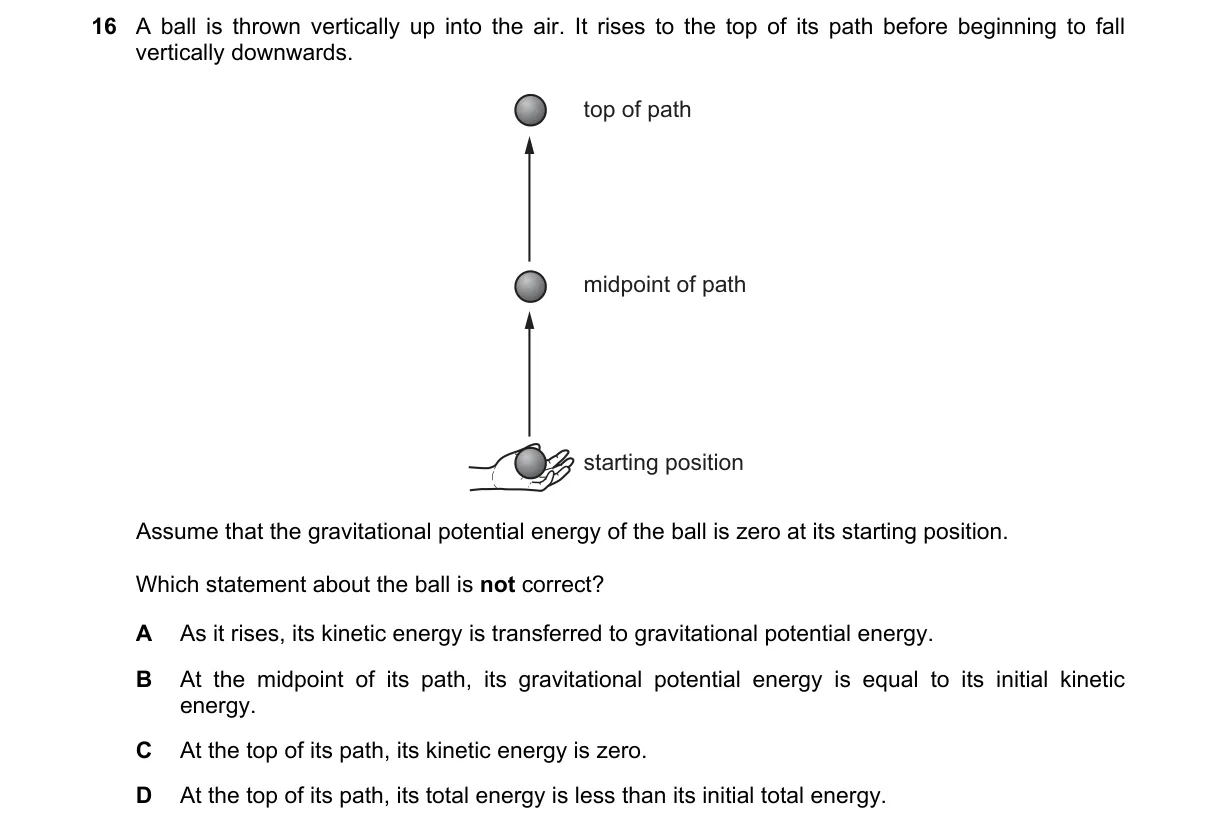
Answer choices
- AAs it rises, kinetic energy is transferred to gravitational potential energy.
- BAt the midpoint of its path, its gravitational potential energy is equal to its initial kinetic energy.
- CAt the top of its path, its kinetic energy is zero.
- DAt the top of its path, its total energy is less than its initial total energy.
Explanation
Conservation of Mechanical Energy
Steps:
- Initial total energy is kinetic energy (KE_i = ½mv²), potential energy (PE) = 0.
- At maximum height H = v²/(2g), PE = mgH = KE_i, KE = 0; total energy conserved.
- Midpoint height = H/2, so PE = mg(H/2) = ½ KE_i; KE = ½ KE_i.
- Compare statements to energy conservation principle.
Why B is correct:
- At midpoint, PE = ½ initial KE (from PE = mgh with h = H/2 and mgH = initial KE), not equal to initial KE.
Why the others are wrong:
- A: Correct, as work against gravity converts KE to PE during ascent.
- C: Correct, velocity is zero at peak, so KE = 0.
- D: Incorrect statement; total energy equals initial total energy, not less (no dissipation assumed).
Final answer: B
Topic: Energy conservation
Practice more A Levels Physics (9702) questions on mMCQ.me