A Levels Physics (9702)•9702/12/M/J/18
A Levels Physics (9702) — 9702/12/M/J/18, Question 38
In the α-particle scattering experiment, a beam of α-particles is aimed at a thin gold foil. Most of the α-particles go straight through or are deflected by small angles. A very small proportion are effectively rebounding towards the source of the α-particles. Which conclusion about the structure of atoms cannot be drawn from this experiment alone?
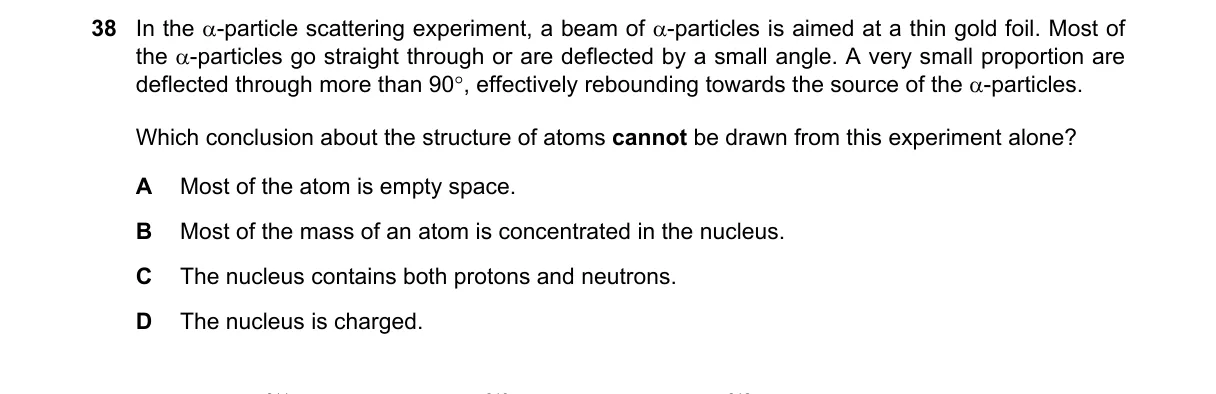
Answer choices
- AMost of the atom is empty space.
- BMost of the mass of an atom is concentrated in the nucleus.
- CThe nucleus contains both protons and neutrons.
- DThe nucleus is charged.
Explanation
Rutherford's experiment infers atomic emptiness and nuclear charge/mass, but not composition.
Steps:
- Observe that most α-particles pass undeflected, indicating atoms are mostly empty space (A).
- Note small-angle deflections from atom's overall mass, but large rebounds require concentrated mass in a tiny nucleus (B).
- Recognize rebounds occur due to electrostatic repulsion, proving the nucleus is positively charged (D).
- Conclude the experiment provides no data on neutral particles like neutrons, so nuclear composition (C) remains unknown.
Why C is correct:
- The scattering follows Coulomb's law for charged particle repulsion, detecting only positive charge and mass density, not neutral neutrons (discovered via separate neutron-proton scattering in 1932).
Why the others are wrong:
- A: Direct from undeflected particles traversing foil without interaction.
- B: Explained by Rutherford's formula for scattering, where large deflections imply dense central mass.
- D: Rebounds result from like-charge repulsion between α-particles and nucleus.
Final answer: C
Topic: Atoms, nuclei and radiation
Practice more A Levels Physics (9702) questions on mMCQ.me