A Levels Physics (9702)•9702/12/M/J/18
A Levels Physics (9702) — 9702/12/M/J/18, Question 36
In the circuit shown, the batteries are identical and all have negligible internal resistance. All resistors have the same resistance. The diodes have zero resistance when conducting and infinite resistance when not conducting. In which circuit is the current in the battery greatest?
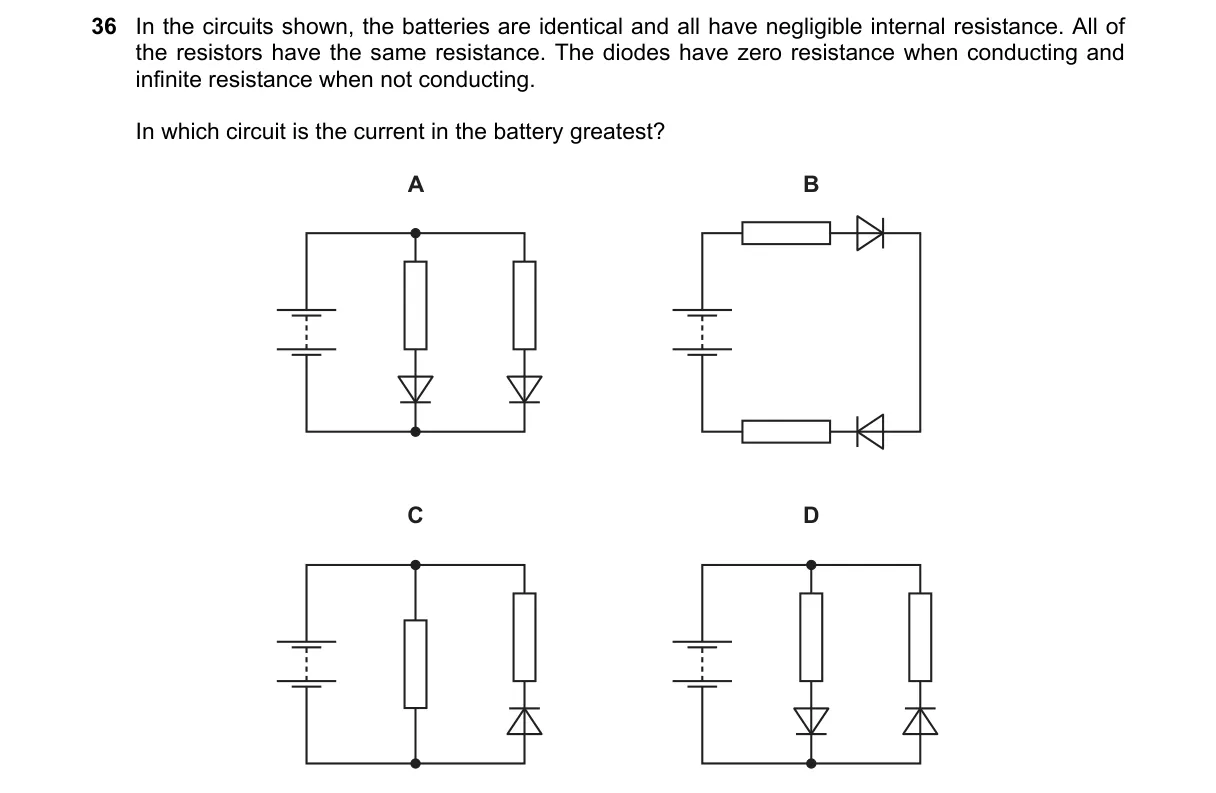
Answer choices
- AOption A
- BOption B
- COption C
- DOption D
Explanation
Diode conduction minimizes effective resistance for maximum battery current
Steps:
- Determine diode states: forward-biased diodes conduct (0 Ω), reverse-biased block (∞ Ω).
- Identify active paths and compute equivalent resistance (R_eq) using series/parallel rules for conducting elements.
- Calculate battery current I = V / R_eq, where V is battery voltage; identical batteries mean highest I for lowest R_eq.
- Compare R_eq across circuits to find minimum.
Why A is correct:
- Both diode branches conduct in parallel, yielding R_eq = R/2 per Ohm's law for parallel resistors, minimizing load.
Why the others are wrong:
- B: One diode blocks, leaving single series path with R_eq = 2R, higher than A.
- C: Diodes create series opposition, R_eq = 3R, even higher resistance.
- D: Reverse diode blocks main path, R_eq ≈ ∞, negligible current.
Final answer: A
Topic: Kirchhoff's laws
Practice more A Levels Physics (9702) questions on mMCQ.me