A Levels Physics (9702)•9702/12/M/J/18
A Levels Physics (9702) — 9702/12/M/J/18, Question 30
Two parallel metal plates X and Y are situated in a vacuum as shown. Plates X and Y carry equal and opposite charges. What happens to the force on a positively charged particle as it moves from plate X to plate Y?
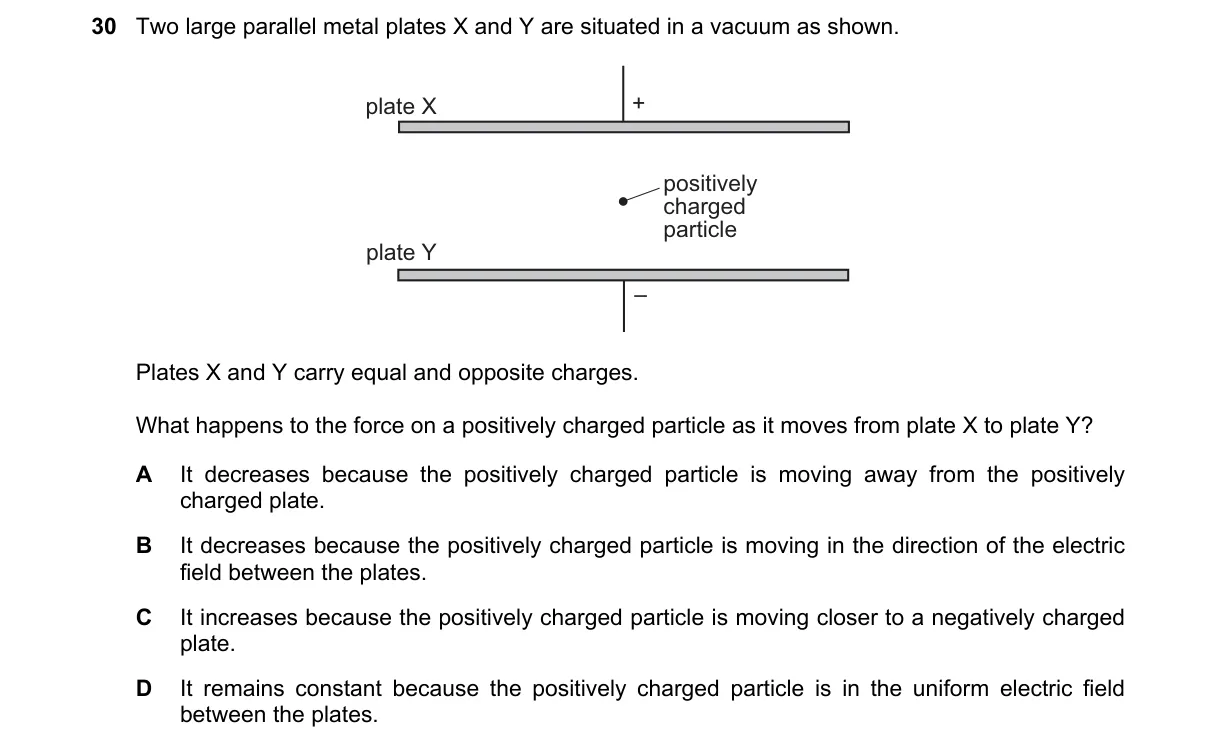
Answer choices
- AIt decreases because the positively charged particle is moving away from the positively charged plate.
- BIt decreases because the positively charged particle is moving closer to the negatively charged plate.
- CIt remains constant because the positively charged particle is in the uniform electric field between the plates.
- DIt increases because the positively charged particle is moving in the direction of the electric field between the plates.
Explanation
Uniform Electric Field in Parallel Plates
Steps:
- Parallel plates with equal opposite charges create a uniform electric field E between them, directed from positive to negative plate.
- Force on a charge q is F = qE; since E is constant in magnitude and direction, F remains constant.
- Positive particle moves from positive plate X toward negative plate Y, along the field direction.
- No variation in field strength occurs between plates, so force magnitude stays the same.
Why C is correct:
- In a uniform electric field, the force on a charged particle is constant, as defined by F = qE where E is uniform.
Why the others are wrong:
- A: Force isn't due to distance from one plate alone; it's the net uniform field.
- B: Attraction to negative plate doesn't change force magnitude in uniform field.
- D: Moving with the field doesn't increase force; magnitude remains constant.
Final answer: C
Topic: Uniform electric fields
Practice more A Levels Physics (9702) questions on mMCQ.me