A Levels Physics (9702)•9702/12/M/J/18
A Levels Physics (9702) — 9702/12/M/J/18, Question 2
The drag coefficient C_d is a number with no units. It is used to compare the drag on different cars at different speeds. C_d is given by the equation C_d = 2F / (v^2 A ρ) where F is the drag on the car, v is the speed of the car, ρ is the density of air, A is the cross-sectional area of the car. What is the value of n?
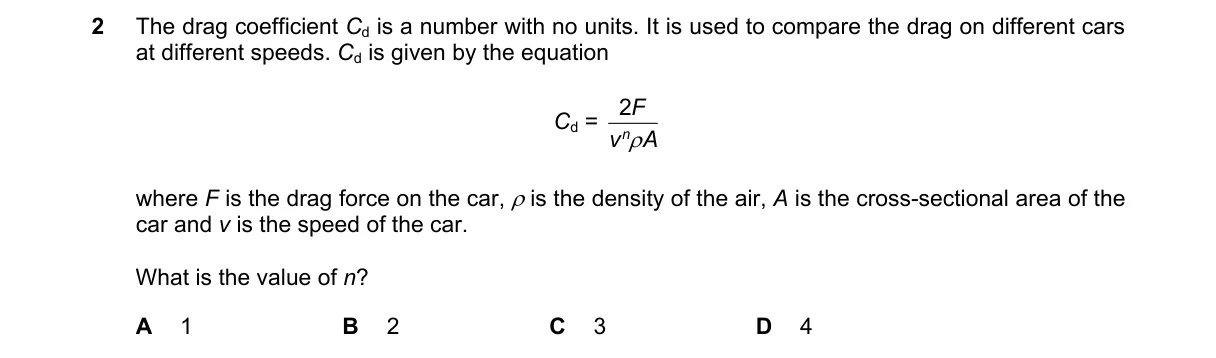
Answer choices
- A1
- B2
- C3
- D4
Explanation
Drag force proportional to speed squared
Steps:
- Recall the standard drag force formula: F = (1/2) C_d ρ A v^2.
- Rearrange to solve for C_d: C_d = 2F / (ρ A v^2), matching the given equation.
- Since C_d is unitless and constant for a shape, F must be proportional to v^2.
- Thus, the exponent n in F ∝ v^n is 2.
Why B is correct:
- The drag equation derives from fluid dynamics, where drag scales with v^2 for most vehicles.
Why the others are wrong:
- A: Linear dependence would imply F ∝ v, but equation shows v^2.
- C: Cubic scaling applies to rare high-speed cases, not standard cars.
- D: Quartic is unrelated to drag physics.
Final answer: B
Topic: Density and pressure
Practice more A Levels Physics (9702) questions on mMCQ.me