A Levels Physics (9702)•9702/11/M/J/18
A Levels Physics (9702) — 9702/11/M/J/18, Question 37
A motor is required to operate at a distance of 800 m from power supply. The motor requires a potential difference (p.d.) of 16 V and a current of 0.5 A to operate. Two wires are used to supply power to the motor as shown. The resistance of each of these wires is 0.05 Ω per metre. What is the minimum output p.d. of the power supply?
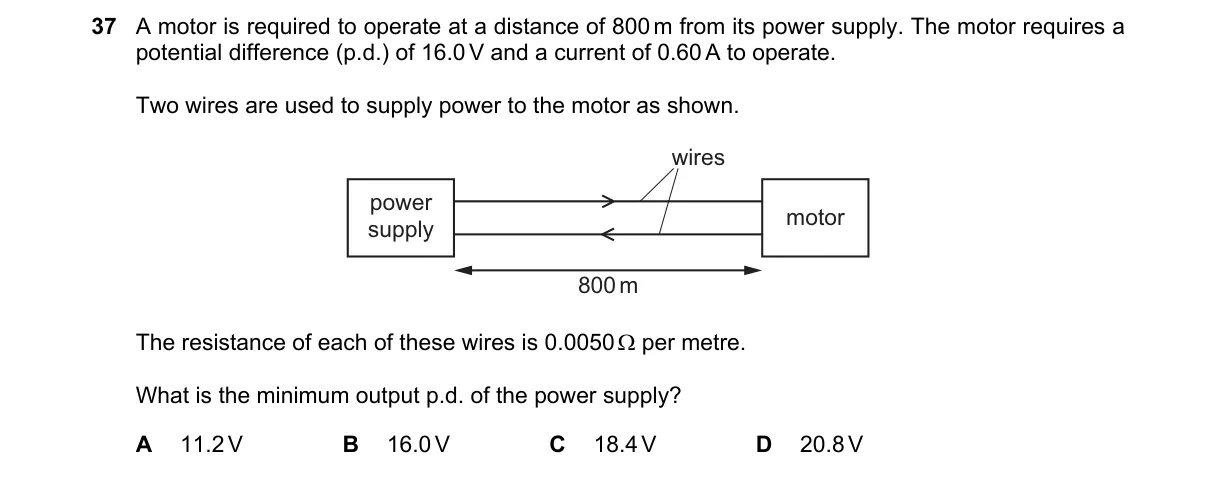
Answer choices
- A11V
- B16V
- C18V
- D20V
Explanation
Voltage drop across supply wires requires higher power supply p.d.
Steps:
- Each wire is 800 m long with resistance 800 × 0.05 Ω/m = 40 Ω.
- Total wire resistance (series for go and return): 40 Ω + 40 Ω = 80 Ω.
- Voltage drop in wires: 0.05 A × 80 Ω = 4 V (using motor current).
- Minimum supply p.d.: 16 V (for motor) + 4 V (drop) = 20 V.
Why D is correct:
- The supply p.d. equals motor p.d. plus I × total wire resistance, per Ohm's law, ensuring 16 V at the motor.
Why the others are wrong:
- A: Subtracts drop from 16 V, ignoring need to compensate.
- B: Ignores voltage drop entirely.
- C: Uses incorrect total resistance (e.g., one wire only).
Final answer: D
Topic: Practical circuits
Practice more A Levels Physics (9702) questions on mMCQ.me