A Levels Physics (9702)•9702/11/M/J/18
A Levels Physics (9702) — 9702/11/M/J/18, Question 18
The diagram shows a wire of diameter D and length L firmly clamped at one end between two blocks of wood. A load is applied to the end which extends by x. The second wire is made of the same material, but of diameter 2D and length L. Both wires obey Hooke's law. What is the extension of the second wire when the same load is applied?
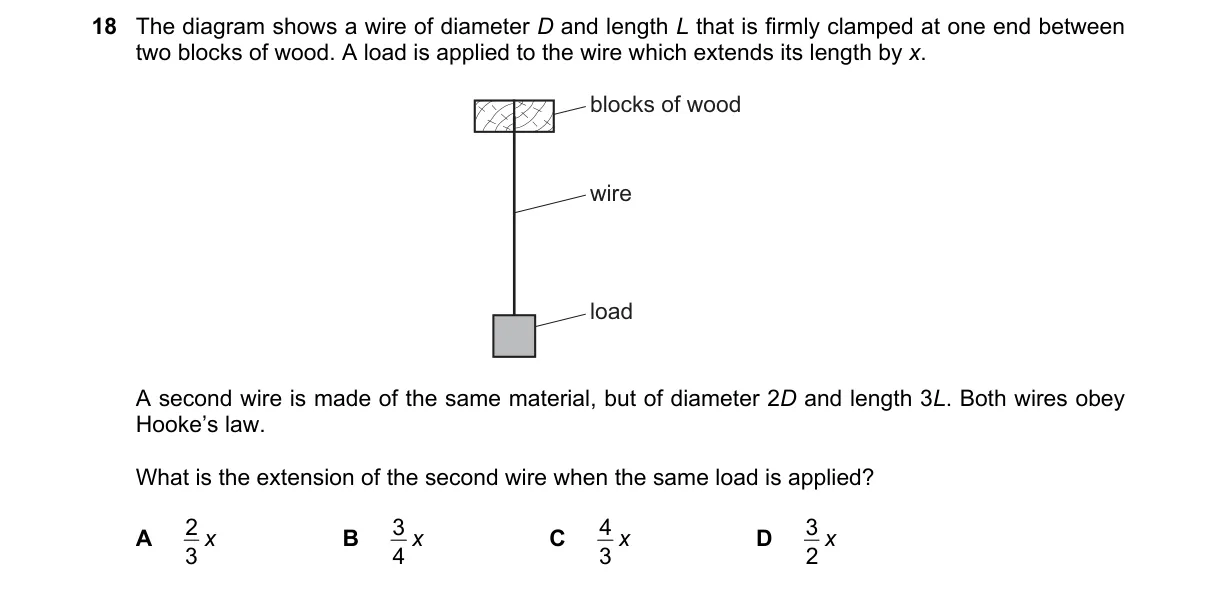
Answer choices
- Ax/3
- Bx/4
- C3x
- Dx/2
Explanation
Extension inversely proportional to cross-sectional area
Steps:
- Use Hooke's law formula: extension ΔL = (F L) / (Y A), where F is load, L length, Y Young's modulus, A area.
- Both wires share F, L, Y; only A differs.
- A ∝ d², so for second wire d=2D, A₂ = 4 A₁.
- ΔL₂ = ΔL₁ / 4 = x/4.
Why B is correct:
- Area quadruples (d² relation), so extension quarters per ΔL = F L / (Y A).
Why the others are wrong:
- A: x/3 misapplies scaling, ignoring d² factor.
- C: 3x assumes area decreases, opposite of reality.
- D: x/2 treats extension linear with diameter, not area.
Final answer: B
Topic: Stress and strain
Practice more A Levels Physics (9702) questions on mMCQ.me