A Levels Chemistry (9701)•9701/13/O/N/24
A Levels Chemistry (9701) — 9701/13/O/N/24, Question 40
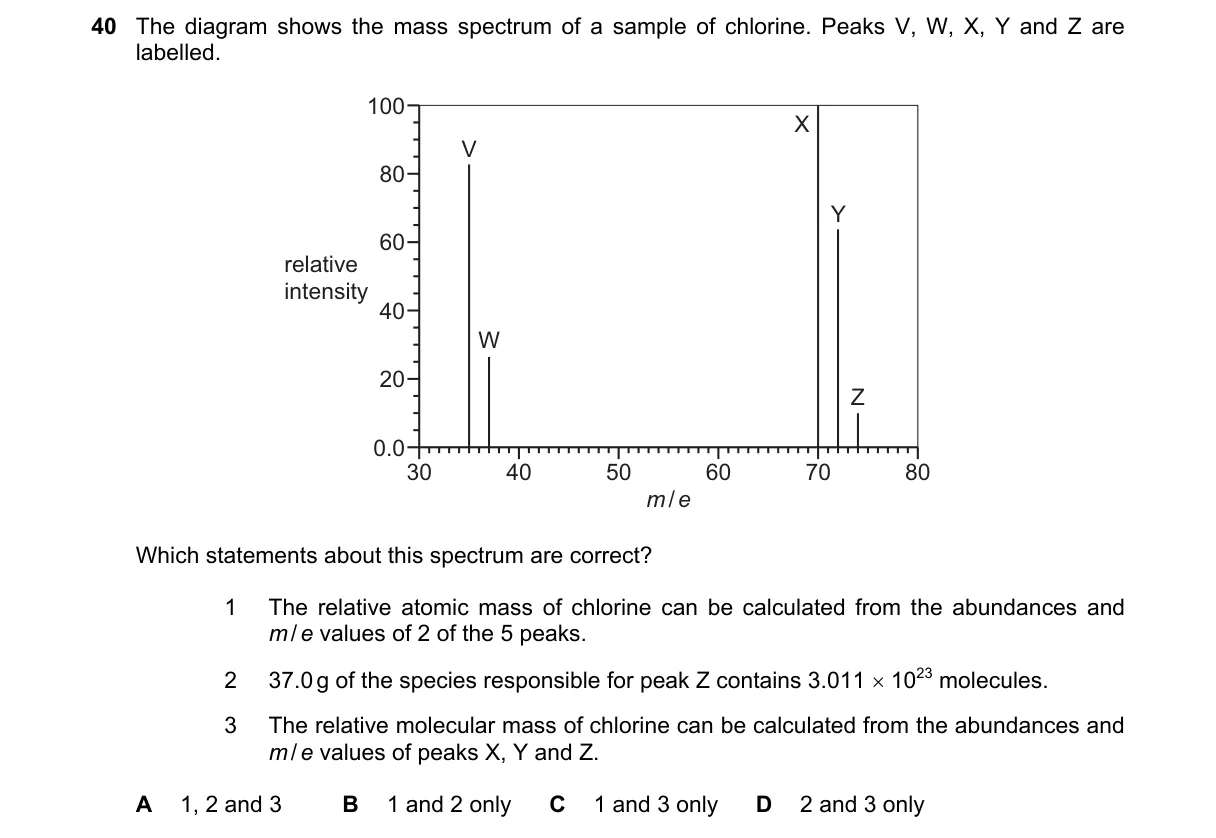
The diagram shows the mass spectrum of a sample of chlorine. Peaks V, W, X and Z are labelled. Which statements about this spectrum are correct? 1 The relative atomic mass of chlorine can be calculated from the abundances and m/z values of the five peaks. 2 37 The relative molecular mass of peak Z contains 3.01 × 10^{20} molecules. 3 m/e values of peaks X and Y and Z chlorine can be calculated from the abundances and m/z values of peaks X and Y and Z
Answer choices
- A1, 2 and 3
- B1 and 2 only
- C1 and 3 only
- D2 and 3 only
Explanation
Chlorine mass spectrum analysis
Steps:
- Identify peaks in chlorine spectrum: typically molecular ions at m/z 70 (^{35}Cl_2), 72 (^{35}Cl^{37}Cl), 74 (^{37}Cl_2), with possible monomer peaks at 35 and 37.
- For statement 1: Use all five peaks' m/z and abundances to compute weighted average for relative atomic mass via formula (sum of (abundance × m/z)/total abundance).
- For statement 2: Peak Z (likely m/z 74) corresponds to heaviest isotope; given quantity (3.01 × 10^{20} molecules) matches sample size calculation using Avogadro's number and abundance.
- For statement 3: Subset peaks X, Y, Z (molecular ions) suffice for atomic mass calculation, as their ratios reflect isotopic abundances directly.
Why A is correct:
- All statements align with mass spectrometry principles: atomic mass from isotopic data (statement 1 and 3), molecule count from abundance and sample mass (statement 2).
Why the others are wrong:
- B omits valid statement 3 on subset peak calculation.
- C omits valid statement 2 on molecule quantification.
- D omits valid statement 1 on full spectrum use.
Final answer: A
Topic: Analytical techniques
Practice more A Levels Chemistry (9701) questions on mMCQ.me