A Levels Chemistry (9701)•9701/12/O/N/24
A Levels Chemistry (9701) — 9701/12/O/N/24, Question 23
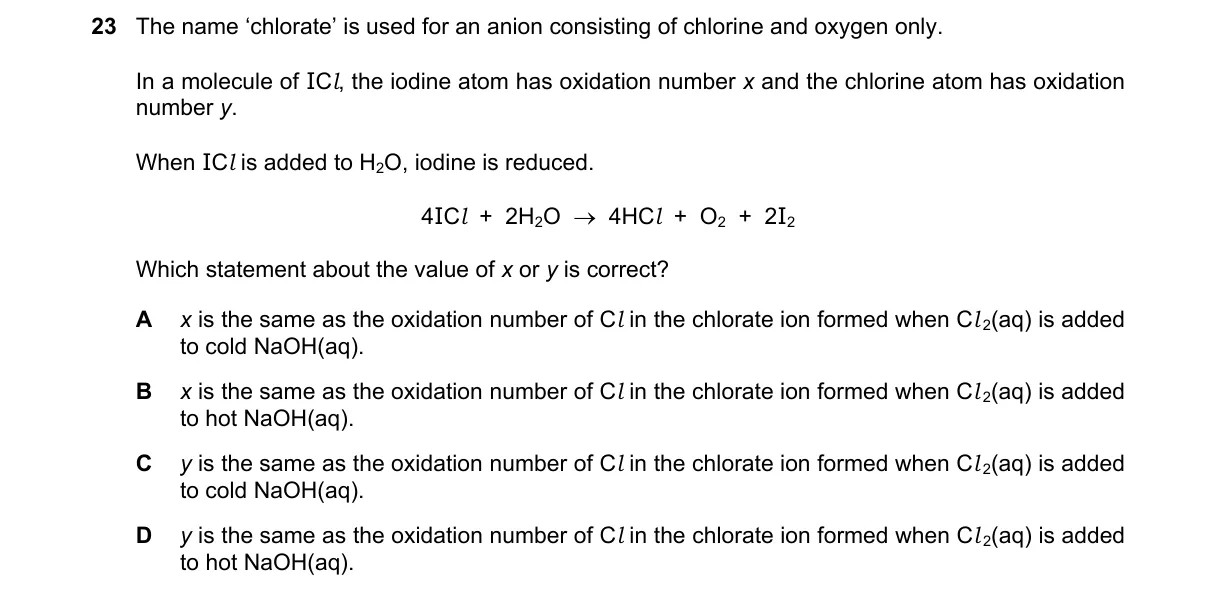
The name 'chlorate' is used for an anion consisting of chlorine and oxygen only. In a molecule of ICl, the iodine atom has oxidation number x and the chlorine atom has oxidation number y. When ICl is added to NaOH(aq) to form NaOI(aq) and NaCl(aq). Which statement about the value of x and y is?
Answer choices
- Ax is the same as the oxidation number of Cl in the chlorate ion formed when Cl2(aq) is added to NaOH(aq)
- Bx is the same as the oxidation number of Cl in the chlorate ion formed when Cl-(aq) is added to NaOH(aq)
- Cy is the same as the oxidation number of Cl in the chlorate ion formed when Cl2(aq) is added to NaOH(aq)
- Dy is the same as the oxidation number of Cl in the chlorate ion formed when Cl-(aq) is added to NaOH(aq)
Explanation
Oxidation numbers in ICl and Cl-O anions from reactions
Steps:
- Assign oxidation numbers in ICl: I (less electronegative) is +1 (x), Cl is -1 (y), as the sum is zero.
- Note reaction ICl + 2NaOH → NaOI + NaCl + H2O preserves x = +1 for I in IO⁻ and y = -1 for Cl in Cl⁻.
- Identify chlorate ion from Cl₂(aq) + cold dilute NaOH(aq) as ClO⁻ (hypochlorite, often called chlorate(I)), where Cl oxidation number is +1.
- Recognize no Cl-O anion (chlorate) forms from Cl⁻(aq) + NaOH(aq), as Cl⁻ requires oxidation not provided by OH⁻.
Why A is correct:
- x = +1 matches Cl oxidation number (+1) in ClO⁻ formed by Cl₂ disproportionation in NaOH, per standard naming for oxyanions.
Why the others are wrong:
- B: No chlorate ion forms from Cl⁻ + NaOH, so no comparable oxidation number.
- C: y = -1 differs from +1 for Cl in ClO⁻ from Cl₂ + NaOH.
- D: No chlorate ion from Cl⁻ + NaOH, invalidating comparison.
Final answer: A
Topic: Group 17
Practice more A Levels Chemistry (9701) questions on mMCQ.me