A Levels Chemistry (9701)•9701/11/O/N/24
A Levels Chemistry (9701) — 9701/11/O/N/24, Question 33
chlorobutane and 1-iodobutane both react with aqueous sodium hydroxide by a nucleophilic substitution mechanism. Which reaction has the greatest rate under the same conditions and which mechanism is followed
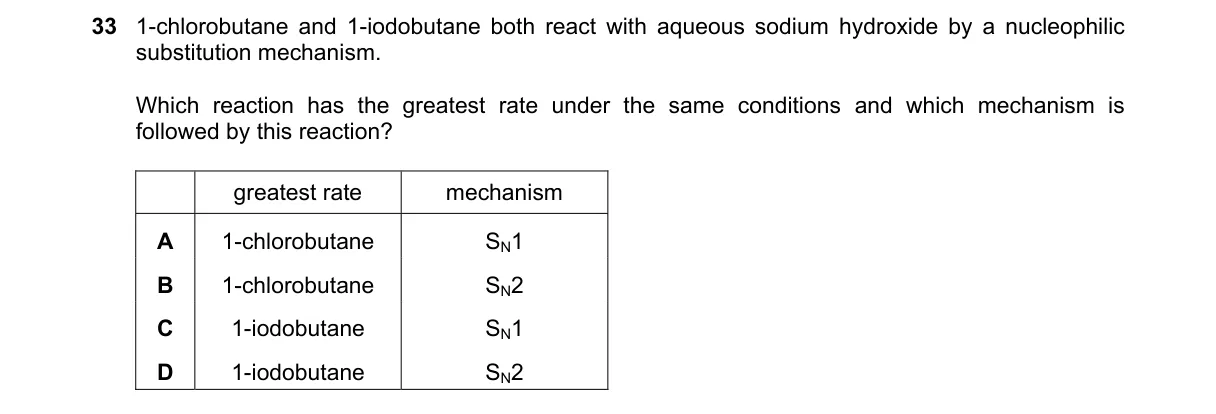
Answer choices
- A1-chlorobutane S_N1
- B1-iodobutane S_N2
- C1-chlorobutane S_N2
- D1-iodobutane S_N1
Explanation
Leaving group ability determines rate in SN2 for primary halides
Steps:
- Both are primary alkyl halides, so mechanism is SN2 with nucleophile OH⁻.
- Aqueous NaOH is polar protic but favors SN2 for primaries due to backside attack preference.
- Leaving group quality: I⁻ > Cl⁻, lowering activation energy for C–X bond break in SN2.
- Thus, 1-iodobutane reacts faster under identical conditions.
Why B is correct:
- Iodide's weaker C–I bond and better leaving group stabilize transition state in SN2, increasing rate constant per rate law: rate = k[RX][OH⁻].
Why the others are wrong:
- A: Chlorine's poor leaving group makes SN1 negligible for primary; rate too slow.
- C: Chlorobutane follows SN2 but slower due to worse leaving group than iodide.
- D: Primaries rarely follow SN1 without stabilization; iodide still prefers SN2 in this setup.
Final answer: B
Topic: Halogen compounds
Practice more A Levels Chemistry (9701) questions on mMCQ.me