A Levels Chemistry (9701)•9701/11/O/N/24
A Levels Chemistry (9701) — 9701/11/O/N/24, Question 21
In reaction 1, concentrated sulfuric acid is added to potassium iodide solution and the fumes produced are bubbled into aqueous potassium iodate solution. In reaction 2, potassium chloride is dissolved in aqueous ammonia and this is then added to aqueous silver nitrate. What are the observations for reaction 1 and 2
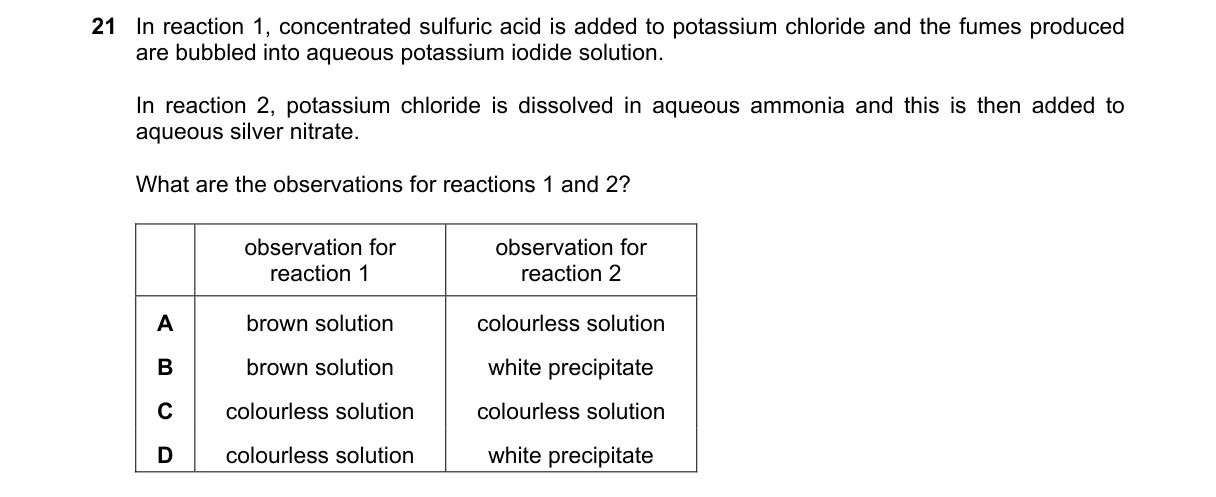
Answer choices
- Abrown solution for reaction 1, colourless solution for reaction 2
- Bbrown solution for reaction 1, white precipitate for reaction 2
- Ccolourless solution for reaction 1, white precipitate for reaction 2
- Dcolourless solution for reaction 1, colourless solution for reaction 2
Explanation
Redox and precipitation observations in halide reactions
Steps:
- Reaction 1: Conc. H₂SO₄ + KI produces I₂ and SO₂ gas (fumes); SO₂ is colorless.
- SO₂ bubbled into KIO₃ reduces iodate to iodide: IO₃⁻ + 3SO₂ + 3H₂O → I⁻ + 3SO₄²⁻ + 6H⁺, forming colorless solution.
- Reaction 2: KCl (in aq. NH₃) + AgNO₃ yields AgCl via Ag⁺ + Cl⁻ → AgCl.
- AgCl forms white precipitate, observable before potential dissolution in NH₃.
Why C is correct:
- Reaction 1 ends with colorless I⁻/SO₄²⁻ solution per the reduction equation; reaction 2 gives white AgCl(s) per solubility rules (Ksp = 1.8 × 10⁻¹⁰).
Why the others are wrong:
- A: Reaction 1 yields colorless, not brown, solution (no free I₂ persists).
- B: Reaction 1 yields colorless, not brown, solution.
- D: Reaction 2 yields white ppt, not colorless solution.
Final answer: C
Topic: Group 17
Practice more A Levels Chemistry (9701) questions on mMCQ.me