A Levels Chemistry (9701)•9701/13/O/N/23
A Levels Chemistry (9701) — 9701/13/O/N/23, Question 34
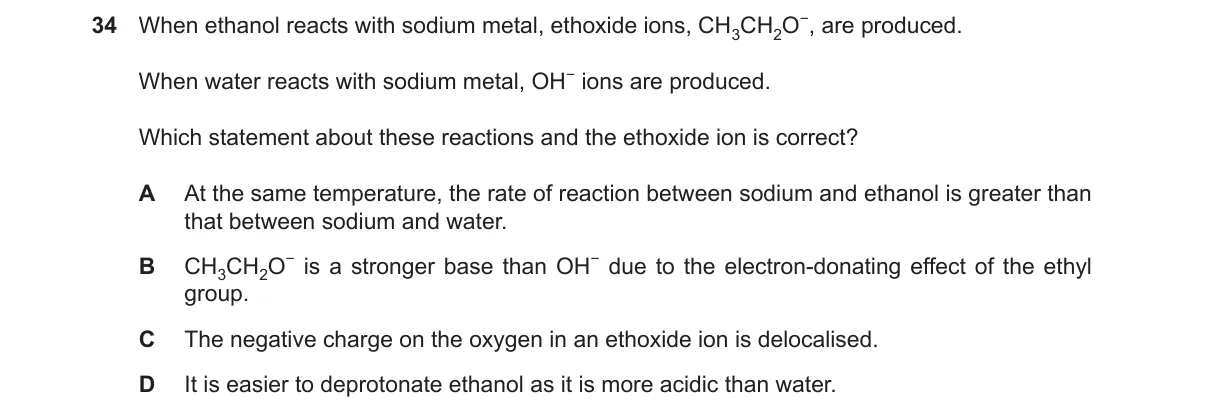
When ethanol reacts with sodium metal, ethoxide ions, CH3CH2O-, are produced. When water reacts with sodium metal, OH- ions are produced. At the same temperature, the rate of the reaction between sodium and ethanol is greater than
Answer choices
- AAt the same temperature, the rate of the reaction between sodium and ethanol is greater than
- BCH3CH2O- is a stronger base than OH- due to the electron-donating effect of ethyl group
- CThe negative charge on the oxygen in an ethoxide ion is delocalised.
- DIt is easier to deprotonate ethanol as it is more acidic than water.
Explanation
Inductive effect enhances basicity of ethoxide ion
Steps:
- Examine products: ethanol + Na yields CH3CH2O-, water + Na yields OH-.
- Assess basicity: stronger base indicates weaker conjugate acid, affecting deprotonation rate.
- Consider substituents: ethyl group in ethoxide exerts +I effect, donating electrons to oxygen.
- Conclude: higher electron density on oxygen makes CH3CH2O- stronger base than OH-.
Why B is correct:
- Electron-donating inductive effect (+I) of alkyl group increases negative charge density on oxygen, strengthening basicity per organic chemistry inductive effects.
Why the others are wrong:
- A: Incomplete and restates the stem without explanation.
- C: Ethoxide charge is localized on oxygen, not delocalized like in resonance-stabilized ions.
- D: Ethanol (pKa 15.9) is less acidic than water (pKa 15.7), so harder to deprotonate.
Final answer: B
Topic: Hydroxy compounds
Practice more A Levels Chemistry (9701) questions on mMCQ.me