A Levels Chemistry (9701) — 9701/13/O/N/23, Question 10
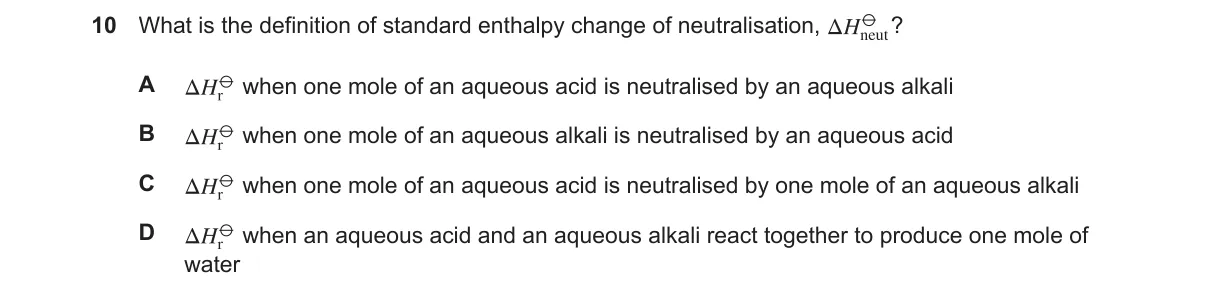
Answer choices
- AΔH° when one mole of an aqueous acid is neutralised by an aqueous alkali
- BΔH° when one mole of aqueous alkali is neutralised by an aqueous acid
- CΔH° when one mole of an aqueous acid is neutralised by one mole of an aqueous alkali
- DΔH° when an aqueous acid and an aqueous alkali react together to produce one mole of water
Explanation
Standard Enthalpy of Neutralisation Defined by Water Formation Steps: - Recall that neutralisation involves acid-base reactions producing water and salt in aqueous solution. - Identify the standard condition: ΔH° measures enthalpy change under standard conditions (298 K, 1 atm). - Focus on the key outcome: the reaction always forms H₂O from H⁺(aq) + OH⁻(aq) → H₂O(l), with ΔH° ≈ -57 kJ/mol for strong acid-strong base. - Compare options: select the one specifying one mole of water as the product, as this standardises the measurement regardless of acid/base amounts. Why D is correct: - By definition, ΔH°_neut is the enthalpy change when one mole of water forms from the reaction of aqueous H⁺ and OH⁻ ions, making it consistent for all strong acid-strong base neutralisations. Why the others are wrong: - A: Omits specifying the amount of alkali, so it doesn't standardise to one mole of water. - B: Focuses on alkali first but still lacks quantification for one mole of water produced. - C: Specifies equal moles of acid and alkali but ignores that the enthalpy is defined per mole …
Practice more A Levels Chemistry (9701) questions on mMCQ.me