A Levels Chemistry (9701)•9701/12/O/N/23
A Levels Chemistry (9701) — 9701/12/O/N/23, Question 37
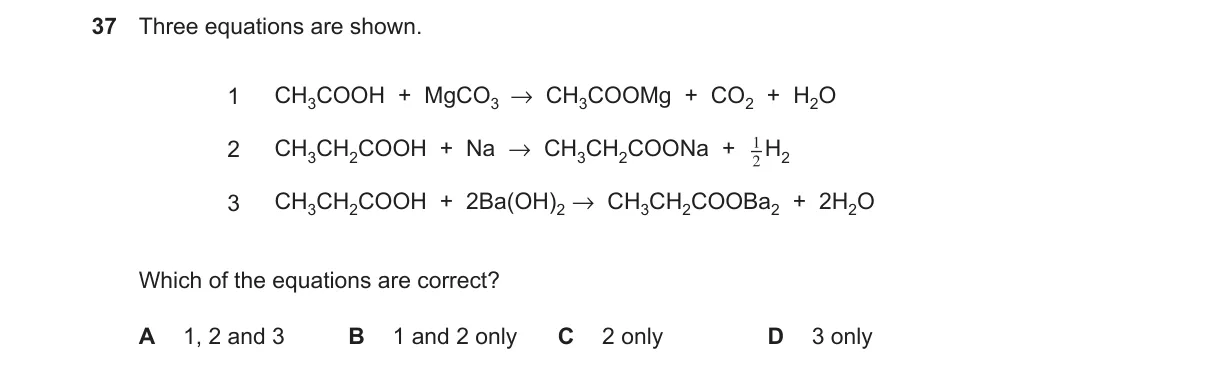
Three equations are shown.
1 CH3COOH + Mg → CH3COOMg + CO2 + H2O
2 CH3COOH + Na → CH3COONa + 1/2 H2
3 CH3COOH + 2Ba(OH)2 → (CH3COO)2Ba + 2H2O
Answer choices
- A1, 2 and 3
- B1 and 2
- C2 only
- D3 only
Explanation
Balanced Chemical Equations for Acid Reactions
Steps:
- Examine atom balance (C, H, O, metals) in each equation for reactants and products.
- Equation 1: Left (C₂H₄O₂ + Mg) has 2C, 4H, 2O, 1Mg; right (C₂H₃O₂Mg + CO₂ + H₂O) has 3C, 4H, 5O, 1Mg—imbalanced C and O.
- Equation 2: Left (C₂H₄O₂ + Na) has 2C, 4H, 2O, 1Na; right (C₂H₃O₂Na + ½H₂) has 2C, 4H (3+1), 2O, 1Na—balanced.
- Equation 3: Left (C₂H₄O₂ + 2Ba(OH)₂) has 2C, 8H, 6O, 2Ba; right ((CH₃COO)₂Ba + 2H₂O) has 4C, 10H, 6O, 1Ba—imbalanced C, H, Ba.
Why C is correct:
- Option C identifies only equation 2 as balanced, per the law of conservation of mass requiring equal atoms on both sides.
Why the others are wrong:
- A: Includes unbalanced equations 1 and 3.
- B: Includes unbalanced equation 1.
- D: Equation 3 has mismatched stoichiometry.
Final answer: C
Topic: Carboxylic acids and derivatives
Practice more A Levels Chemistry (9701) questions on mMCQ.me