A Levels Chemistry (9701)•9701/12/O/N/23
A Levels Chemistry (9701) — 9701/12/O/N/23, Question 30
The structure of compound X is shown. One mole of compound X reacts completely with two moles of hydrogen bromide. What is the structure of the major product of this reaction?
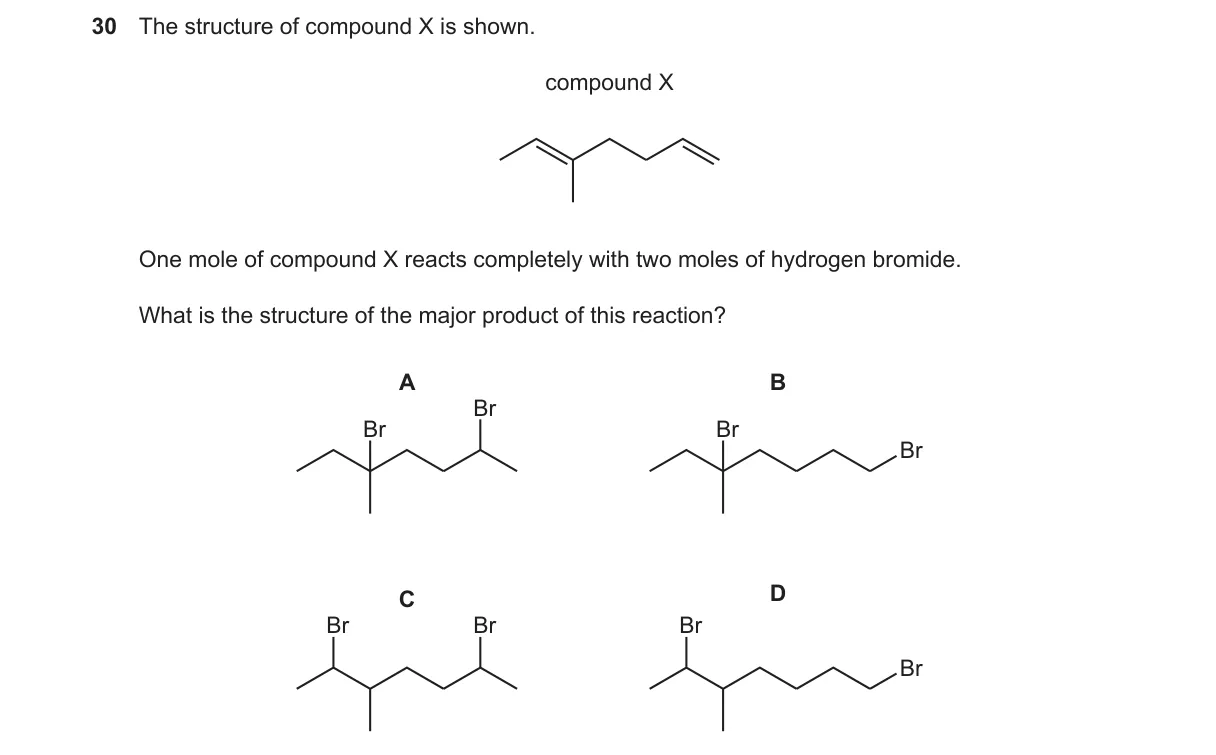
Answer choices
- AOption A
- BOption B
- COption C
- DOption D
Explanation
Conjugated diene undergoes 1,4-addition with HBr
Steps:
- Compound X is a conjugated diene, allowing electrophilic addition of two HBr molecules.
- First HBr adds via protonation at one double bond, forming a resonance-stabilized allylic carbocation.
- Bromide attacks the carbocation at the 1,4-position (major) or 1,2-position (minor).
- Second HBr adds to the remaining double bond in the 1,4-product, yielding the saturated dibromide.
Why A is correct:
- A shows the 1,4-dibromide product, following Markovnikov's rule for conjugated systems where the major pathway stabilizes the allylic intermediate.
Why the others are wrong:
- B: Represents 1,2-addition product after first HBr, ignoring second addition.
- C: Shows anti-Markovnikov orientation, violating regioselectivity in HBr addition.
- D: Depicts a non-conjugated or incorrect skeletal structure, not matching diene reactivity.
Final answer: A
Topic: Hydrocarbons
Practice more A Levels Chemistry (9701) questions on mMCQ.me