A Levels Chemistry (9701)•9701/12/O/N/23
A Levels Chemistry (9701) — 9701/12/O/N/23, Question 25
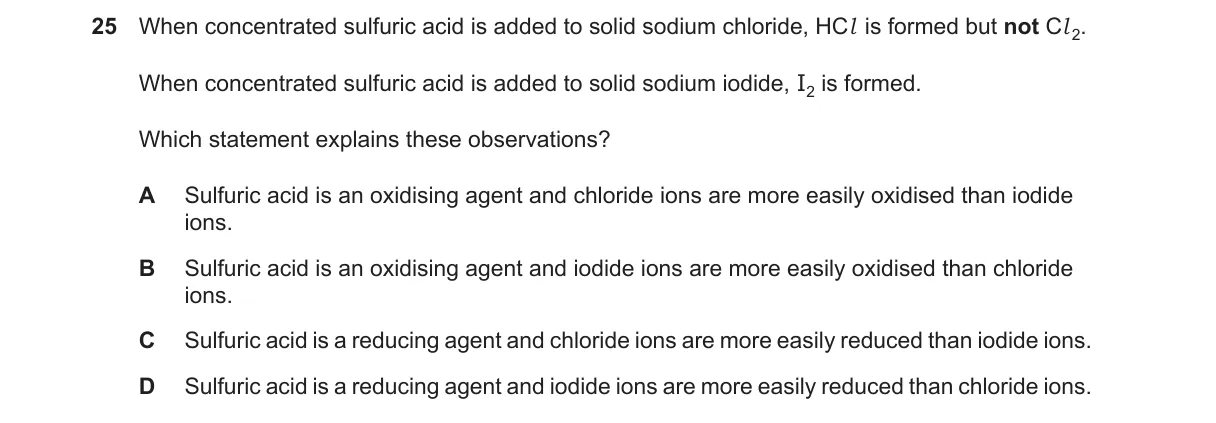
When concentrated sulfuric acid is added to solid sodium chloride, HCl is formed but not Cl2. When concentrated sulfuric acid is added to solid sodium iodide, I2 is formed. Which statement explains these observations?
Answer choices
- ASulfuric acid is an oxidizing agent and chloride ions are more easily oxidized than iodide
- BSulfuric acid is an oxidizing agent and iodide ions are more easily oxidized than chloride
- CSulfuric acid is a reducing agent and chloride ions are more easily reduced than iodide ions.
- DSulfuric acid is a reducing agent and iodide ions are more easily reduced than chloride ions.
Explanation
Sulfuric acid oxidizes iodide but not chloride
Steps:
- Concentrated H2SO4 reacts with NaCl to form HCl, indicating no oxidation of Cl⁻.
- With NaI, I₂ forms, showing oxidation of I⁻ to I₂ by H2SO4.
- H2SO4 acts as an oxidizing agent in these reactions.
- Standard reduction potential for I₂/2I⁻ (+0.54 V) is lower than Cl₂/2Cl⁻ (+1.36 V), so I⁻ is easier to oxidize.
Why B is correct:
- Iodide ions are more easily oxidized than chloride ions, as their lower reduction potential means H2SO4 can oxidize I⁻ to I₂ but not Cl⁻ to Cl₂.
Why the others are wrong:
- A: Chloride ions are harder to oxidize than iodide, not easier.
- C: Sulfuric acid acts as an oxidizing agent here, not reducing.
- D: Sulfuric acid is not a reducing agent, and iodide ions are harder to reduce than chloride.
Final answer: B
Topic: Group 17
Practice more A Levels Chemistry (9701) questions on mMCQ.me