A Levels Chemistry (9701)•9701/12/O/N/23
A Levels Chemistry (9701) — 9701/12/O/N/23, Question 24
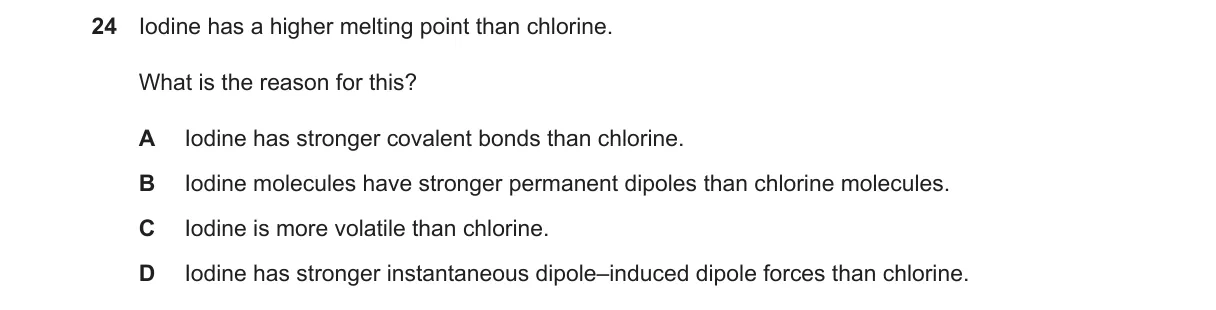
Iodine has a higher melting point than chlorine. What is the reason for this?
Answer choices
- AIodine has stronger covalent bonds than chlorine.
- BIodine molecules have stronger permanent dipoles than chlorine molecules.
- CIodine is more volatile than chlorine.
- DIodine has stronger instantaneous dipole-induced dipole forces than chlorine.
Explanation
Intermolecular forces explain higher melting point of iodine
Steps:
- Both chlorine (Cl₂) and iodine (I₂) are nonpolar diatomic molecules, so intermolecular forces dominate melting points.
- For nonpolar molecules, London dispersion forces (instantaneous dipole-induced dipole) are the key intermolecular attractions.
- These forces increase with molecular size and number of electrons, making larger I₂ have stronger attractions than smaller Cl₂.
- Stronger forces require more energy to overcome, resulting in iodine's higher melting point.
Why D is correct:
- Instantaneous dipole-induced dipole forces (London dispersion) strengthen with atomic size due to greater electron cloud polarizability, as per the trend in van der Waals forces for halogens.
Why the others are wrong:
- A: Covalent bonds are intramolecular and similar in strength; they do not directly cause higher melting points in molecular solids.
- B: Neither molecule has permanent dipoles, as both are symmetrical and nonpolar.
- C: Higher melting point indicates lower volatility for iodine, not higher.
Final answer: D
Topic: Group 17
Practice more A Levels Chemistry (9701) questions on mMCQ.me