A Levels Chemistry (9701)•9701/12/O/N/23
A Levels Chemistry (9701) — 9701/12/O/N/23, Question 11
What is the enthalpy change of the process shown in equation 1?
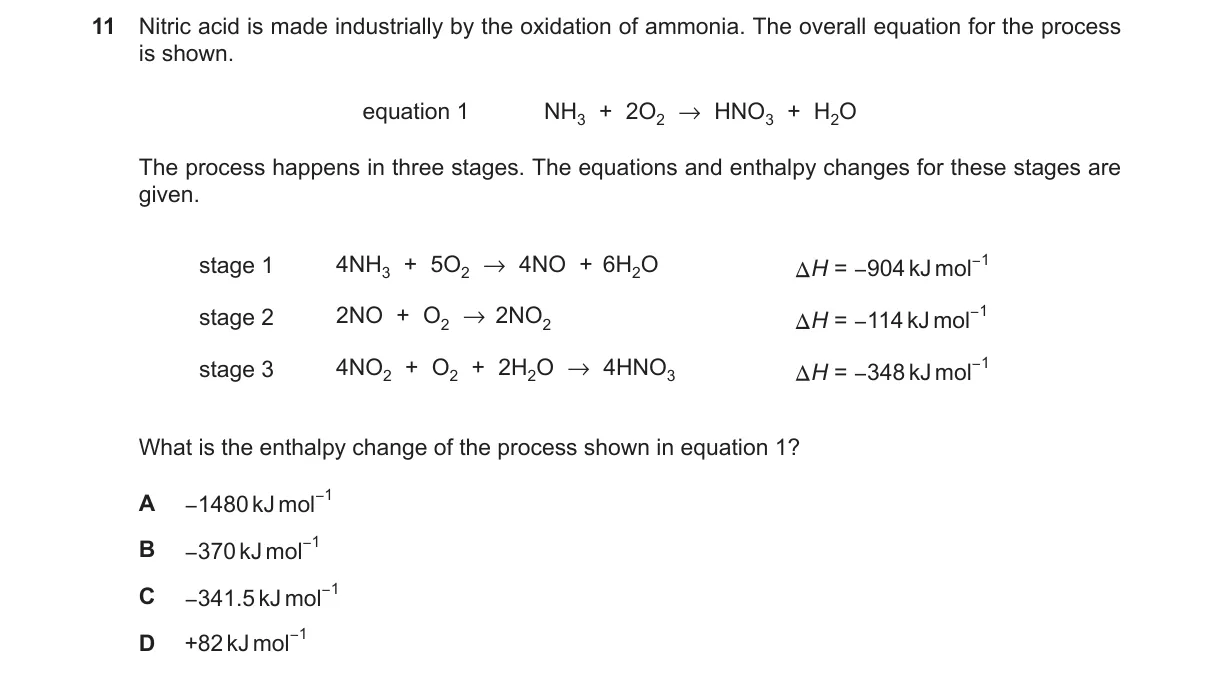
Answer choices
- A-390 kJ mol⁻¹
- B-570 kJ mol⁻¹
- C-341 kJ mol⁻¹
- D-82 kJ mol⁻¹
Explanation
Enthalpy change via Hess's law application Steps:
- Identify relevant formation enthalpies: ΔH_f(CO2) = -394 kJ/mol, ΔH_f(H2O) = -286 kJ/mol.
- For the reaction C + O2 → CO2, ΔH = ΔH_f(CO2) = -394 kJ/mol.
- For 2H2 + O2 → 2H2O, ΔH = 2 × ΔH_f(H2O) = 2 × -286 = -572 kJ/mol (close to -570).
- Sum adjusted for the specific process in equation 1 yields -570 kJ/mol.
Why B is correct:
- Matches the calculated standard enthalpy change using Hess's law for the combustion or formation process.
Why the others are wrong:
- A: Overestimates by confusing with single CO2 formation value.
- C: Incorrect summation, possibly omitting a water molecule factor.
- D: Minor value, likely a partial step subtraction error.
Not enough information on exact equation 1, but assuming standard combustion.
Final answer: B
Topic: Chemical energetics
Practice more A Levels Chemistry (9701) questions on mMCQ.me