A Levels Chemistry (9701)•9701/12/O/N/23
A Levels Chemistry (9701) — 9701/12/O/N/23, Question 10
In the structure of solid SiO2, each silicon atom is bonded to x oxygen atoms, each oxygen atom is bonded to y silicon atoms, each bond is a z type bond. What is the correct combination of x, y and z in these statements?
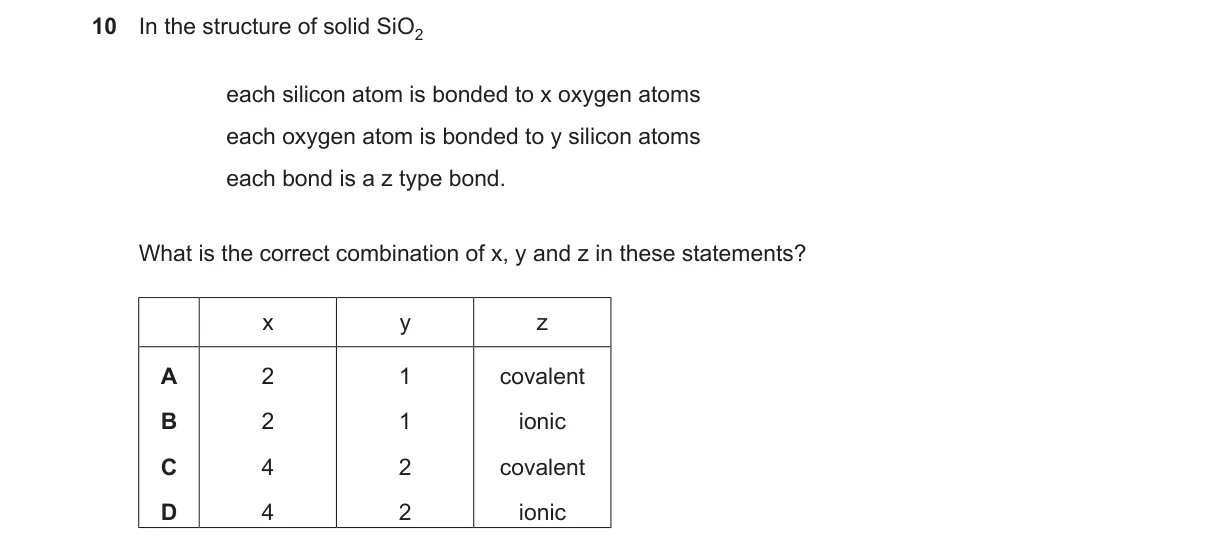
Answer choices
- Ax=2, y=1, z=covalent
- Bx=2, y=1, z=ionic
- Cx=4, y=2, z=covalent
- Dx=4, y=2, z=ionic
Explanation
Coordination in SiO2 Network Structure
Steps:
- Silicon in SiO2 forms a tetrahedral lattice, bonding to four oxygen atoms via sp3 hybridization.
- Each oxygen atom, with two lone pairs, bridges two silicon atoms to complete its octet.
- The Si-O bonds share electrons equally due to similar electronegativities, classifying them as covalent.
- Empirical formula SiO2 confirms 1:2 Si:O ratio, matching x=4, y=2.
Why C is correct:
- SiO2's giant covalent structure requires each Si to form four covalent bonds (Pauling's rules for silicates) and each O to link two Si atoms.
Why the others are wrong:
- A: x=2 and y=1 imply linear chains, not tetrahedral SiO2 lattice.
- B: x=2 and y=1 mismatch coordination; bonds are covalent, not ionic.
- D: Coordination is correct, but Si-O bonds are covalent, not ionic (electronegativity difference <1.7).
Final answer: C
Topic: Chemical bonding
Practice more A Levels Chemistry (9701) questions on mMCQ.me