A Levels Chemistry (9701)•9701/11/O/N/23
A Levels Chemistry (9701) — 9701/11/O/N/23, Question 34
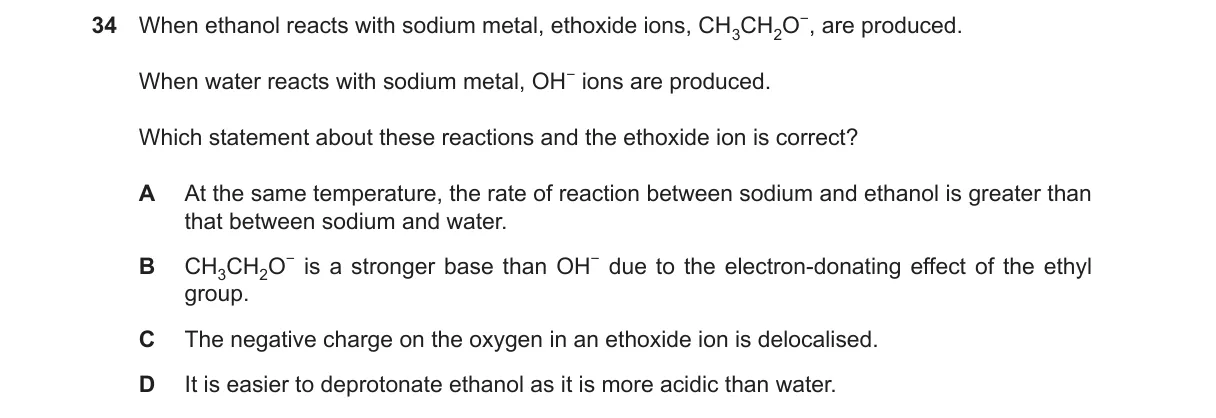
When ethanol reacts with sodium metal, ethoxide ions, CH3CH2O–, are produced. When water reacts with sodium metal, OH– ions are produced. Which statement is correct?
Answer choices
- AAt the same temperature, the rate of the reaction between sodium and ethanol is greater than the rate with water.
- BCH3CH2O– is a stronger base than OH– due to the electron-donating effect of the ethyl group.
- CThe negative charge on the oxygen in an ethoxide ion is delocalised.
- DIt is easier to deprotonate ethanol as it is more acidic than water.
Explanation
Basicity of ethoxide vs. hydroxide ions
Steps:
- Compare pKa values: water (15.7) is more acidic than ethanol (15.9), so OH⁻ is weaker base than CH₃CH₂O⁻.
- Conjugate base strength: weaker acid yields stronger conjugate base, confirming ethoxide as stronger base.
- Electron effects: ethyl group donates electrons inductively, raising electron density on oxygen in ethoxide.
- Reaction implication: stronger base aligns with slower sodium-ethanol reaction vs. water.
Why B is correct:
- Inductive effect: electron-donating ethyl group increases electron density on oxygen (Pauling electronegativity), making ethoxide more willing to accept protons than OH⁻.
Why the others are wrong:
- A: Water reaction is faster; higher acidity of water facilitates quicker deprotonation by sodium.
- C: Charge in ethoxide is localized on oxygen; no conjugation or resonance for delocalization.
- D: Ethanol is less acidic (higher pKa), so harder to deprotonate than water.
Final answer: B
Topic: Hydroxy compounds
Practice more A Levels Chemistry (9701) questions on mMCQ.me