A Levels Chemistry (9701)•9701/11/O/N/23
A Levels Chemistry (9701) — 9701/11/O/N/23, Question 32
Propanoic acid can be made from bromoethane using a two-stage synthesis. Which pair of reagents is most suitable?
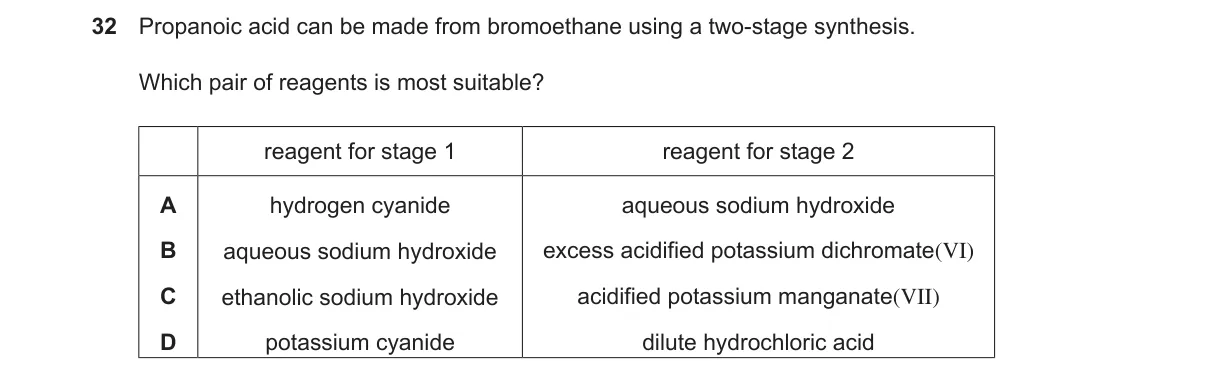
Answer choices
- Areagent for stage 1: aqueous sodium cyanide; reagent for stage 2: excess acidified potassium dichromate(VI)
- Breagent for stage 1: aqueous sodium hydroxide; reagent for stage 2: excess acidified sodium dichromate(VI)
- Creagent for stage 1: ethanolic sodium hydroxide; reagent for stage 2: acidified potassium manganate(VII)
- Dreagent for stage 1: potassium cyanide; reagent for stage 2: dilute hydrochloric acid
Explanation
Nucleophilic substitution to nitrile, then hydrolysis to carboxylic acid
Steps:
- Bromoethane (CH₃CH₂Br) undergoes SN2 substitution with CN⁻ from KCN to form propanenitrile (CH₃CH₂CN).
- Propanenitrile hydrolyzes under acidic conditions with dilute HCl, adding H₂O across the nitrile to yield propanoic acid (CH₃CH₂COOH).
- This two-stage process extends the carbon chain by one atom, matching the required product.
- No oxidation or elimination occurs, preserving the chain length.
Why D is correct:
- KCN in ethanol (implied for substitution) gives the nitrile; dilute HCl provides H⁺ for partial hydrolysis to the acid without decarboxylation.
Why the others are wrong:
- A: Aqueous NaCN risks early hydrolysis to hydroxy acid; K₂Cr₂O₇ oxidizes, not hydrolyzes, nitriles.
- B: Aqueous NaOH substitutes to ethanol (CH₃CH₂OH); Na₂Cr₂O₇ oxidizes to ethanoic acid (one less carbon).
- C: Ethanolic NaOH eliminates to ethene; KMnO₄ cleaves to CO₂, not propanoic acid.
Final answer: D
Topic: Organic synthesis
Practice more A Levels Chemistry (9701) questions on mMCQ.me