A Levels Chemistry (9701)•9701/11/O/N/23
A Levels Chemistry (9701) — 9701/11/O/N/23, Question 11
HOCl is the molecule that kills bacteria when chlorine is added to water. The following reaction Cl2(g) + H2O(l) = HOCl(aq) + H+(aq) + Cl-(aq). Which statement is correct?
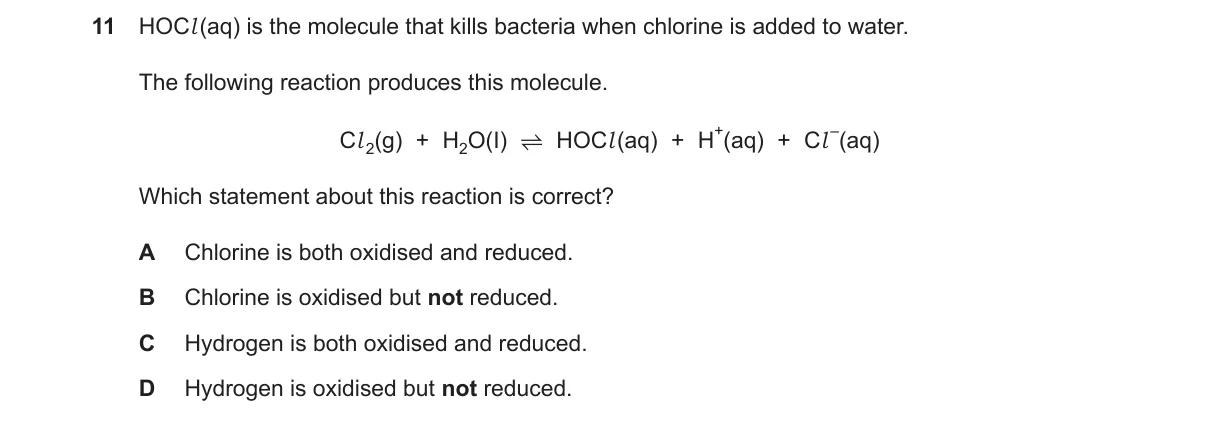
Answer choices
- AChlorine is both oxidized and reduced.
- BChlorine is oxidized but not reduced.
- CHydrogen is oxidized but not reduced.
- DHydrogen is oxidized but not reduced.
Explanation
Chlorine Disproportionation in Aqueous Solution
Steps:
- Assign oxidation states: In Cl₂, Cl is 0; in H₂O, H is +1 and O is -2.
- In products, Cl in HOCl is +1 (H +1, O -2, so Cl +1); Cl in Cl⁻ is -1; H in H⁺ is +1.
- One Cl atom oxidizes from 0 to +1 in HOCl, losing electrons.
- Another Cl atom reduces from 0 to -1 in Cl⁻, gaining electrons.
Why A is correct:
- This is a disproportionation reaction, where chlorine is simultaneously oxidized and reduced, per the definition of redox processes involving the same element.
Why the others are wrong:
- B: Chlorine is also reduced to Cl⁻, not just oxidized.
- C: Hydrogen's oxidation state remains +1 in both H₂O and H⁺, so it is neither oxidized nor reduced.
- D: Identical to C; hydrogen shows no redox change.
Final answer: A
Topic: Electrochemistry
Practice more A Levels Chemistry (9701) questions on mMCQ.me