A Levels Chemistry (9701)•9701/13/O/N/22
A Levels Chemistry (9701) — 9701/13/O/N/22, Question 32
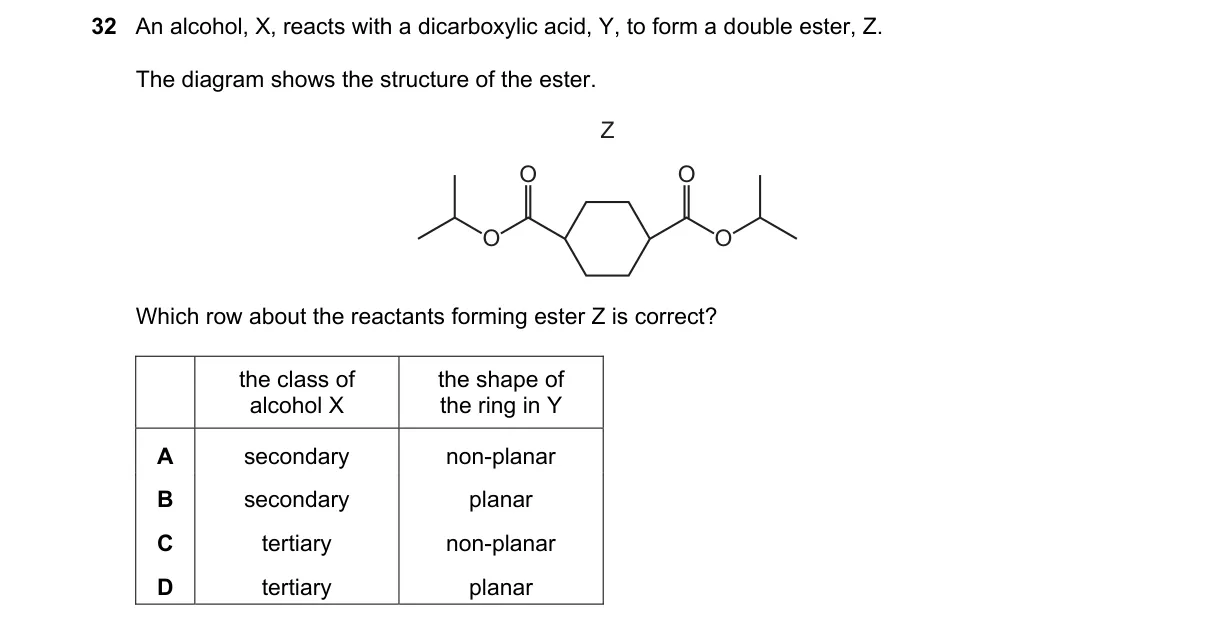
An alcohol, X, reacts with a dicarboxylic acid, Y, to form a double ester, Z. The diagram shows the structure of Z. Which row about the reactants forming ester Z is correct?
Answer choices
- Aclass of alcohol X: secondary, the shape of Y: non-planar, the shape of ring in Z: non-planar
- Bclass of alcohol X: secondary, the shape of Y: planar, the shape of ring in Z: non-planar
- Cclass of alcohol X: tertiary, the shape of Y: non-planar, the shape of ring in Z: planar
- Dclass of alcohol X: tertiary, the shape of Y: planar, the shape of ring in Z: non-planar
Explanation
Ester structure reveals alcohol type and ring geometry
Steps:
- Analyze Z's ester groups: the carbon attached to -O- in the alcohol part has two alkyl substituents, classifying X as secondary.
- Identify Y as a dicarboxylic acid with a flexible chain, making it non-planar in its reactive form.
- Observe Z's ring: formed by esterification, it adopts a puckered conformation due to bond angles, rendering it non-planar.
- Match these features to option A, confirming the double ester cycle.
Why A is correct:
- Secondary alcohol X forms esters where the -OH carbon bonds to two carbons, and non-planar Y (e.g., aliphatic chain) cyclizes to a non-planar ring in Z per standard cyclic ester geometry.
Why the others are wrong:
- B: Y is non-planar, not planar, as dicarboxylic acids lack aromatic rigidity.
- C: X is secondary, not tertiary (tertiary lacks H for esterification); Z ring is non-planar.
- D: X is secondary, not tertiary; Y is non-planar.
Final answer: A
Topic: Carboxylic acids and derivatives
Practice more A Levels Chemistry (9701) questions on mMCQ.me