A Levels Chemistry (9701)•9701/13/O/N/22
A Levels Chemistry (9701) — 9701/13/O/N/22, Question 25
Separate 1.0g samples of Na2O,MgO,Al2O3,SiO2,NaCl,MgCl2,AlCl3,SiCl4 are added to separate beakers containing water and stirred. An excess of NaOH(aq) is then added to each beaker and stirred. The number of beakers containing a white solid is Q. The number of beakers now containing a white solid is R. Which row is correct?
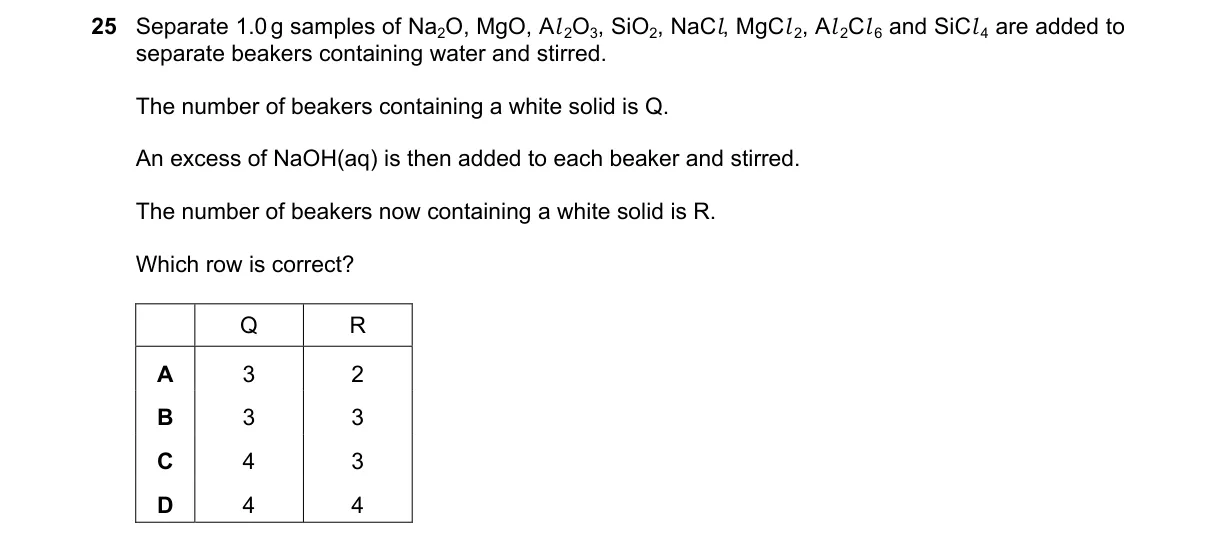
Answer choices
- A3 3
- B3 2
- C4 3
- D4 4
Explanation
Insolubility of oxides and hydrolysis products in water and NaOH Steps:
- Identify initial white solids (Q): Na2O dissolves to NaOH; MgO forms insoluble Mg(OH)2; Al2O3 insoluble; SiO2 insoluble; NaCl, MgCl2, AlCl3 dissolve (AlCl3 hydrolyzes partially, clear solution); SiCl4 hydrolyzes to insoluble Si(OH)4. Thus, 4 beakers (MgO, Al2O3, SiO2, SiCl4).
- After excess NaOH(aq): Mg(OH)2 remains insoluble; Al2O3 and SiO2 unchanged (insoluble in dilute aqueous NaOH); Si(OH)4 dissolves to Na2SiO3; MgCl2 forms insoluble Mg(OH)2; AlCl3 forms then redissolves Al(OH)3 to aluminate; others clear. Thus, 4 beakers (MgO, Al2O3, SiO2, MgCl2). Why D is correct:
- Matches Q=4 initial insoluble/hydrolysis products and R=4 final insoluble in dilute NaOH(aq), per solubility rules for these compounds. Why the others are wrong:
- A: Underestimates both (ignores SiCl4 initial, MgCl2 final).
- B: Underestimates Q (ignores SiCl4), correct R not 2.
- C: Correct Q but underestimates R (ignores MgCl2 forming Mg(OH)2).
Final answer: D
Topic: The Periodic Table: chemical periodicity
Practice more A Levels Chemistry (9701) questions on mMCQ.me