A Levels Chemistry (9701)•9701/12/O/N/22
A Levels Chemistry (9701) — 9701/12/O/N/22, Question 37
Propyl propanoate is synthesized in three steps using propanenitrile as the only organic starting material. In step 1, the nitrile is converted into compound X. In step 2, compound X is converted into compound Y. In step 3, compound Y is reacted with more of compound X to give propyl propanoate. Which reagents are suitable for carrying out step 1 and step 2?
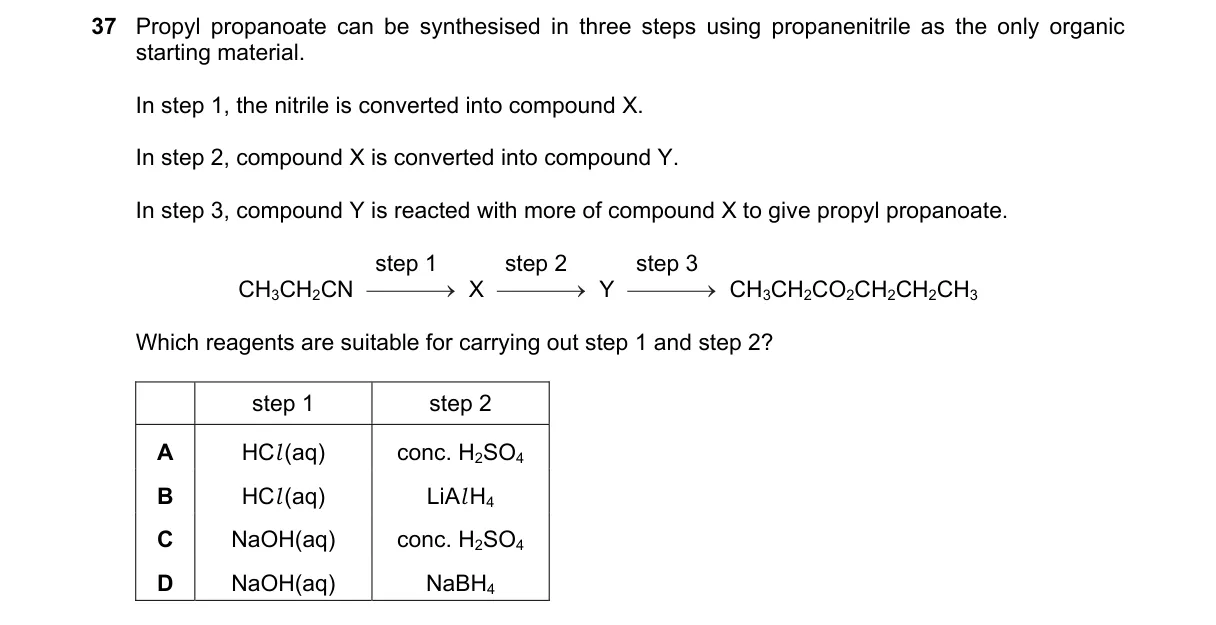
Answer choices
- AHCl(aq) conc. H2SO4
- BNaOH(aq) LiAlH4
- COption C
- DNaOH(aq) NaBH4
Explanation
Nitrile hydrolysis to acid, then reduction to alcohol for esterification
Steps:
- Hydrolyze propanenitrile (CH3CH2CN) with NaOH(aq) to propanoate salt, acidify to propanoic acid (X = CH3CH2COOH).
- Reduce X with LiAlH4 to propan-1-ol (Y = CH3CH2CH2OH).
- React Y with X under acidic conditions to form propyl propanoate (CH3CH2COOCH2CH2CH3).
- Confirms three-step synthesis using only propanenitrile-derived compounds.
Why B is correct:
- NaOH(aq) hydrolyzes nitriles to carboxylates (R-CN + 2H2O + OH- → R-COO- + NH3), and LiAlH4 reduces carboxylic acids to primary alcohols (RCOOH + 4[LiH] → RCH2OH + ...).
Why the others are wrong:
- A: HCl(aq) hydrolyzes nitrile but conc. H2SO4 dehydrates amides, not reducing acid to alcohol.
- C: Option incomplete, lacks valid reagents.
- D: NaBH4 reduces aldehydes/ketones but not carboxylic acids or nitriles effectively.
Final answer: B
Topic: Organic synthesis
Practice more A Levels Chemistry (9701) questions on mMCQ.me