A Levels Chemistry (9701)•9701/12/O/N/22
A Levels Chemistry (9701) — 9701/12/O/N/22, Question 32
Which isomer of C4H9Cl will form the most stable cation intermediate?
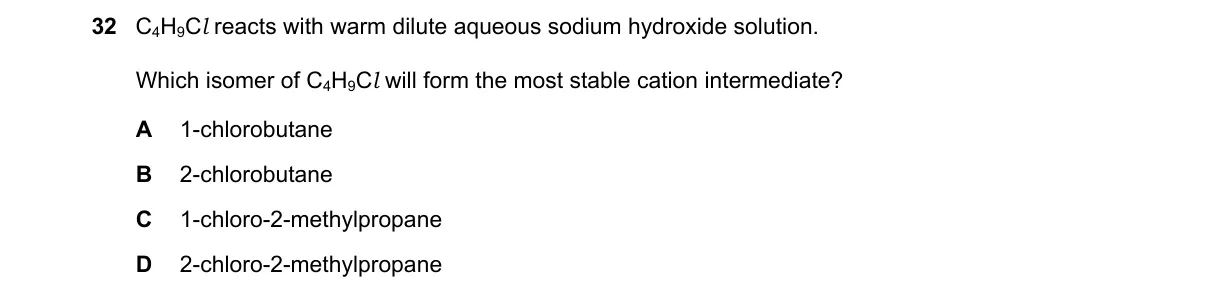
Answer choices
- A1-chlorobutane
- B2-chlorobutane
- C1-chloro-2-methylpropane
- D2-chloro-2-methylpropane
Explanation
Carbocation stability increases with substitution: tertiary > secondary > primary
Steps:
- Determine the carbocation formed by loss of Cl⁻ from each isomer.
- Classify each as primary, secondary, or tertiary based on the carbon attached to Cl.
- Recall that stability follows the order tertiary (most stable) > secondary > primary due to hyperconjugation and inductive effects.
- Select the isomer yielding the tertiary carbocation.
Why D is correct:
- 2-Chloro-2-methylpropane forms (CH₃)₃C⁺, a tertiary carbocation stabilized by three alkyl groups through hyperconjugation and +I effect.
Why the others are wrong:
- A: Forms primary carbocation CH₃CH₂CH₂CH₂⁺, least stable with minimal alkyl substitution.
- B: Forms secondary carbocation CH₃CH₂CH⁺CH₃, less stable than tertiary with only two alkyl groups.
- C: Forms primary carbocation (CH₃)₂CHCH₂⁺, least stable with minimal alkyl substitution.
Final answer: D
Topic: Halogen compounds
Practice more A Levels Chemistry (9701) questions on mMCQ.me