A Levels Chemistry (9701)•9701/12/O/N/22
A Levels Chemistry (9701) — 9701/12/O/N/22, Question 27
A carboxylic acid, P, has no chain isomers. It reacts with an alcohol, Q, that has only one positional isomer. What would be the ester formed from a reaction between P and Q?
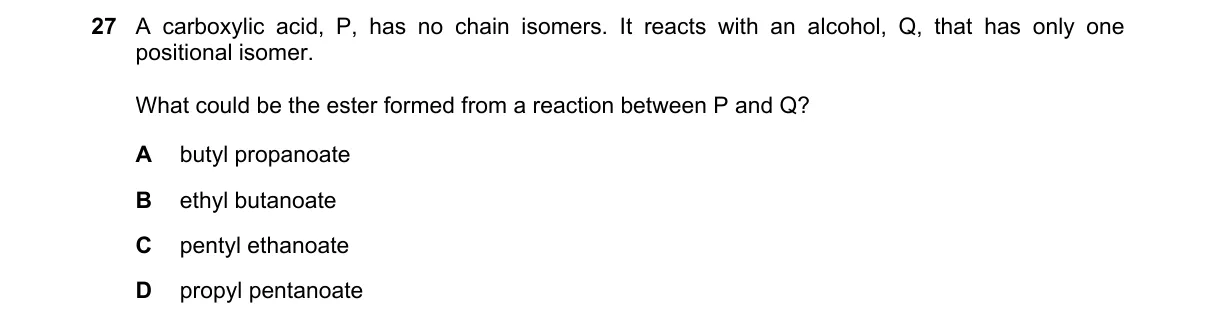
Answer choices
- Abutyl propanoate
- Bethyl butanoate
- Cpropyl ethanoate
- Dpropyl pentanoate
Explanation
Identifying acid P and alcohol Q from isomer constraints Steps:
- Carboxylic acid P has no chain isomers, so P is propanoic acid (formula CH₃CH₂COOH; 3 total carbons prevent branching).
- Alcohol Q has only one positional isomer, so Q is butan-1-ol (straight-chain C4; primary OH position is unique, secondary considered distinct type).
- Ester name is alkyl (from Q) + alkanoate (from P): butyl + propanoate.
- Match to choices: butyl propanoate is option A.
Why A is correct:
- Propanoic acid (CH₃CH₂COOH) has no chain isomers per structural formula, as the ethyl group cannot branch; butan-1-ol has only one positional isomer for primary OH on unbranched chain.
Why the others are wrong:
- B: Butanoic acid has chain isomer (2-methylpropanoic acid, (CH₃)₂CHCOOH).
- C: Propanol has two positional isomers (1-propanol, CH₃CH₂CH₂OH; 2-propanol, CH₃CH(OH)CH₃).
- D: Pentanoic acid has multiple chain isomers (e.g., 2-methylbutanoic acid).
Final answer: A
Topic: Carboxylic acids and derivatives
Practice more A Levels Chemistry (9701) questions on mMCQ.me