A Levels Chemistry (9701)•9701/12/O/N/22
A Levels Chemistry (9701) — 9701/12/O/N/22, Question 24
Photochemical smog is a type of air pollution produced in urban areas by the effect of sun on substances released from vehicle exhausts. Which mixture of primary pollutants leads to the formation of photochemical smog?
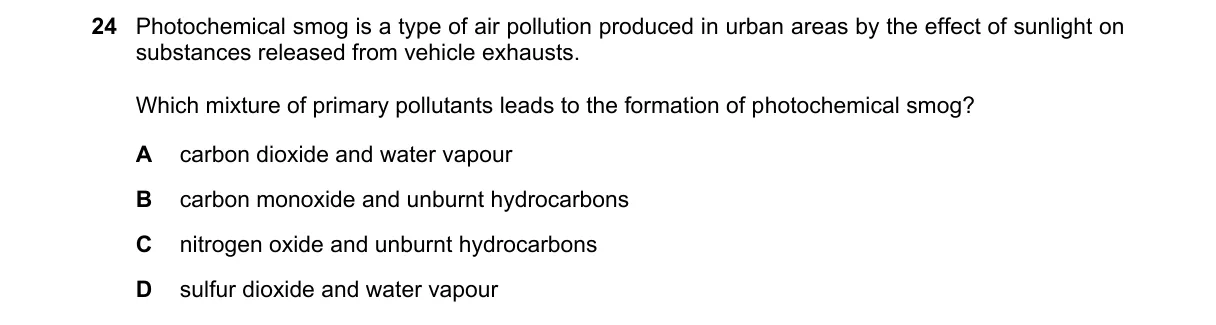
Answer choices
- Acarbon monoxide and water vapour
- Bcarbon monoxide and unburnt hydrocarbons
- Cnitrogen oxide and unburnt hydrocarbons
- Dsulfur dioxide and water vapour
Explanation
Photochemical smog from NOx and hydrocarbons
Steps:
- Identify primary pollutants in vehicle exhaust: nitrogen oxides (NOx) and unburnt hydrocarbons.
- Recall that sunlight triggers photochemical reactions between NOx and hydrocarbons to form smog.
- Eliminate options without both key pollutants.
- Confirm the mixture that reacts under UV light to produce ozone and other oxidants.
Why C is correct:
- Nitrogen oxides (NOx) and unburnt hydrocarbons undergo photochemical oxidation in sunlight, forming peroxyacyl nitrates (PAN) and ozone, as per the reaction: NOx + VOCs + hν → photochemical smog components.
Why the others are wrong:
- A: Carbon monoxide and water vapor do not participate in the key photochemical reactions for smog.
- B: Carbon monoxide alone with hydrocarbons lacks NOx, which initiates the chain reaction.
- D: Sulfur dioxide and water vapor contribute to acid rain, not photochemical smog.
Final answer: C
Topic: Reaction kinetics
Practice more A Levels Chemistry (9701) questions on mMCQ.me