A Levels Chemistry (9701)•9701/12/O/N/22
A Levels Chemistry (9701) — 9701/12/O/N/22, Question 20
In the diagram, each test-tube W, X and Z contains 25 cm³ of 0.1 mol dm⁻³ solution of a salt. To test-tubes W and X, 25 cm³ of 0.1 mol dm⁻³ NaOH(aq) is added. To test-tubes Y and Z, 25 cm³ of 0.1 mol dm⁻³ H₂SO₄(aq) is added. In which of the test-tubes W and X does the liquid have the higher pH and which of test-tubes Y and Z has the greater mass of precipitate
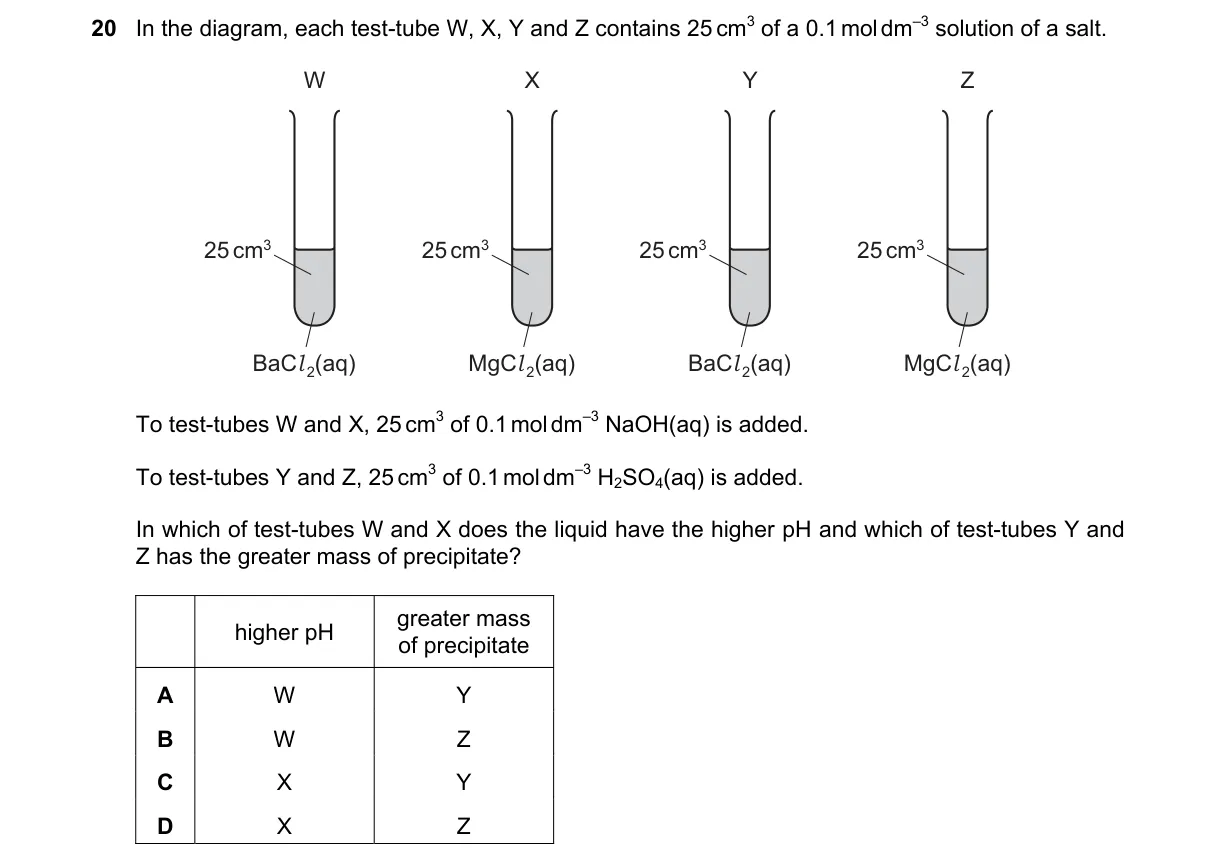
Answer choices
- Ahigher pH W, greater mass of precipitate Y
- Bhigher pH X, greater mass of precipitate Z
- Chigher pH X, greater mass of precipitate Y
- Dhigher pH X, greater mass of precipitate Z
Explanation
Salt reactions with NaOH affect pH; with H₂SO₄ form precipitates based on solubility
Steps:
- Identify salts in W and X from diagram: W contains NH₄Cl (weak base cation), X contains NaCl (neutral).
- Adding NaOH to W liberates NH₃ gas, increasing [OH⁻] more than in X, so pH higher in W.
- Identify salts in Y and Z: Y contains BaCl₂, Z contains CaCl₂.
- Adding H₂SO₄ to Y forms BaSO₄ (Ksp very low, complete precipitation, 0.0025 mol), to Z forms CaSO₄ (Ksp higher, partial precipitation, less than 0.0025 mol), so greater mass in Y.
Why A is correct:
- A matches: NH₄⁺ in W yields higher pH via NH₃ evolution; Ba²⁺ in Y yields more BaSO₄ precipitate per solubility rules.
Why the others are wrong:
- B: pH higher in X (neutral, lower pH than W); precipitate in Z (less CaSO₄).
- C: precipitate in Y correct, but pH higher in X (wrong, W higher).
- D: pH higher in X (wrong); precipitate in Z (less mass).
Final answer: A
Topic: Group 2
Practice more A Levels Chemistry (9701) questions on mMCQ.me