A Levels Chemistry (9701)•9701/12/O/N/22
A Levels Chemistry (9701) — 9701/12/O/N/22, Question 11
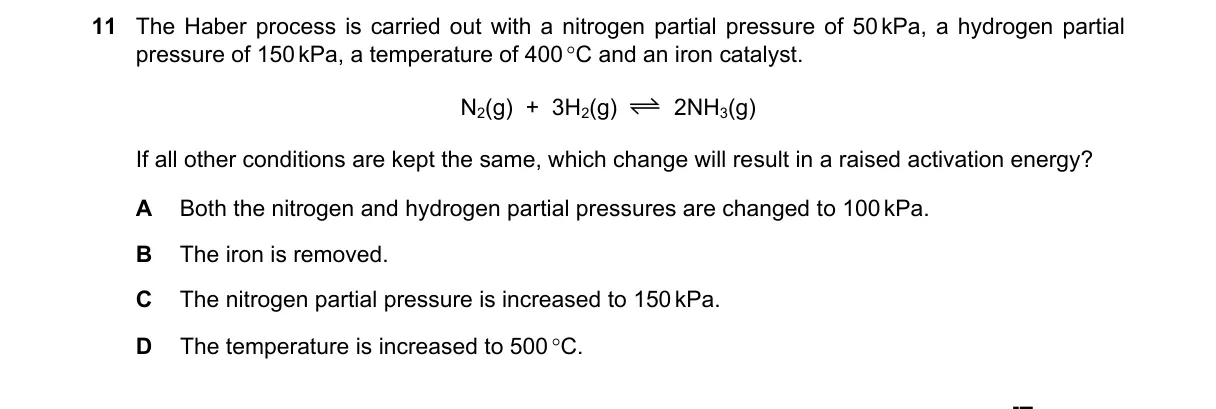
The Haber process is carried out with a nitrogen partial pressure of 50 kPa, a hydrogen partial pressure of 150 kPa, temperature of 400°C and iron catalyst. N₂(g) + 3H₂(g) ⇌ 2NH₃(g). If all other conditions are kept the same, which change will result in a raised activation energy?
Answer choices
- ABoth the nitrogen and hydrogen partial pressures are increased to 100 kPa.
- BThe iron catalyst is removed.
- CThe nitrogen partial pressure is increased to 150 kPa.
- DThe temperature is increased to 500°C.
Explanation
Activation energy depends on reaction pathway, altered only by catalysts
Steps:
- Activation energy (Ea) is the energy barrier for the reaction, determined by the pathway.
- Catalysts lower Ea by offering a lower-energy alternative route.
- Removing the catalyst reverts to the original, higher Ea pathway.
- Pressure and temperature changes affect collision frequency or energy distribution but not Ea.
Why B is correct:
- Catalysts reduce Ea per transition state theory; removal restores the uncatalyzed, higher Ea.
Why the others are wrong:
- A: Increases reactant concentrations, raising rate via collision theory but Ea unchanged.
- C: Alters nitrogen concentration, affecting equilibrium shift and rate but not Ea.
- D: Raises kinetic energy of molecules, increasing rate per Arrhenius equation (k = Ae^(-Ea/RT)) but Ea fixed.
Final answer: B
Topic: Reaction kinetics
Practice more A Levels Chemistry (9701) questions on mMCQ.me