A Levels Chemistry (9701)•9701/11/O/N/22
A Levels Chemistry (9701) — 9701/11/O/N/22, Question 39
The monomer buta-1,3-diene can undergo addition polymerisation in various ways. Two of the polymers that can be made are called cis-polybuta-1,3-diene and trans-polybuta-1,3-diene (the names have their usual meanings). What is the structure of the repeat unit of cis-polybuta-1,3-diene?
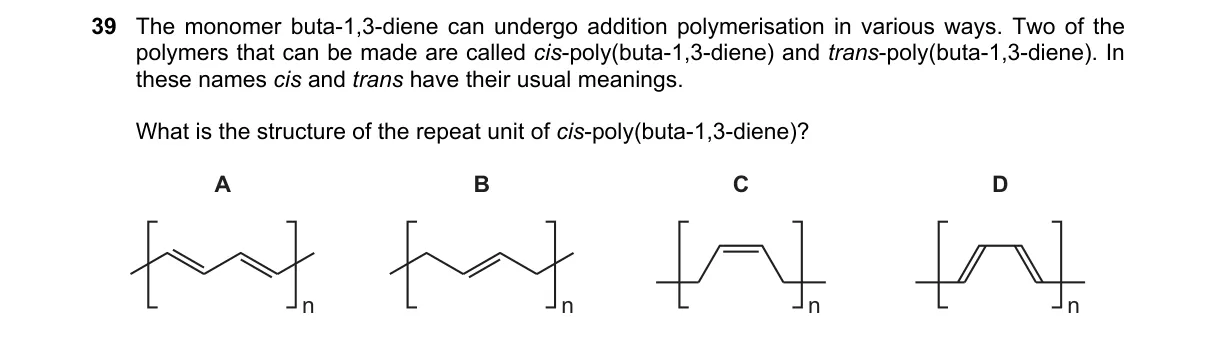
Answer choices
- A(-CH2-CH=CH-CH2-)n
- B(-CH2-CH=CH2-CH-)n
- C(=CH-CH2-CH=CH2-)n
- D(-CH=CH-CH=CH-)n
Explanation
1,4-Addition Polymerization of Buta-1,3-Diene
Steps:
- Buta-1,3-diene monomer is CH2=CH-CH=CH2 with conjugated double bonds.
- In addition polymerization, 1,4-addition occurs when the chain bonds to carbon 1 of one monomer and carbon 4 of the next.
- This leaves a cis or trans double bond between carbons 2 and 3 in the backbone.
- The resulting repeat unit is -CH2-CH=CH-CH2-, with cis specifying the double bond geometry.
Why A is correct:
- It represents the standard 1,4-addition repeat unit for cis-polybuta-1,3-diene, as defined in polymer chemistry for retaining one double bond per monomer.
Why the others are wrong:
- B: Shows incorrect bonding (-CH2-CH=CH2-CH-), with a terminal =CH2 not matching butadiene's polymerization.
- C: Depicts a vinyl-like unit (=CH-CH2-CH=CH2-), typical of 1,2-addition but not the linear 1,4-backbone.
- D: Indicates fully conjugated -CH=CH-CH=CH-, which would require no single bonds added, unlike actual polymerization.
Final answer: A
Topic: Polymerisation
Practice more A Levels Chemistry (9701) questions on mMCQ.me