A Levels Chemistry (9701)•9701/13/O/N/21
A Levels Chemistry (9701) — 9701/13/O/N/21, Question 26
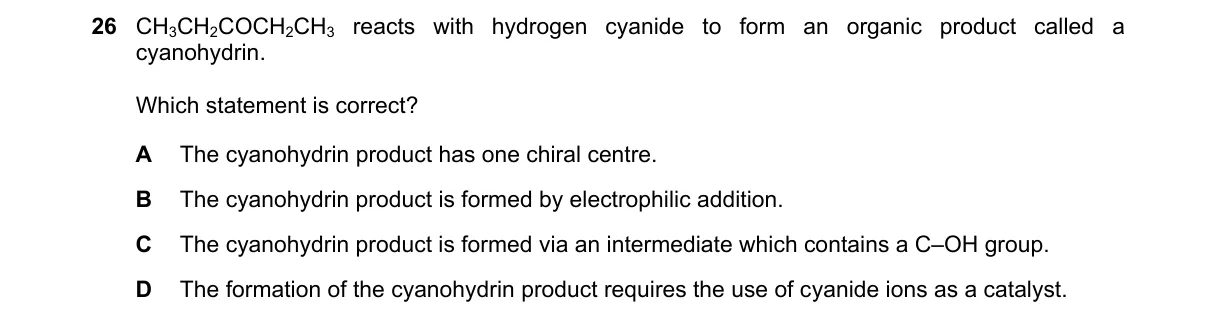
CH3COCH3 reacts with hydrogen cyanide to form an organic product called a cyanohydrin. Which statement is correct?
Answer choices
- AThe cyanohydrin product has one chiral centre.
- BThe cyanohydrin is formed by electrophilic addition which contains -OH group.
- CThe cyanohydrin product formed intermediate which contains -CN group.
- DThe formation of cyanohydrin product requires the use of cyanide as a catalyst.
Explanation
Cyanohydrin Formation Mechanism Steps:
- Acetone (CH3COCH3) is a ketone that undergoes nucleophilic addition with HCN.
- CN⁻ attacks the electrophilic carbonyl carbon, forming a tetrahedral alkoxide intermediate.
- The alkoxide abstracts a proton from HCN, yielding the cyanohydrin CH3C(OH)(CN)CH3 and regenerating CN⁻.
- This shows CN⁻ acts catalytically, as it is regenerated and not net consumed.
Why D is correct:
- Cyanide ion (CN⁻) catalyzes the reaction by serving as the nucleophile in addition and being regenerated via proton transfer from HCN, per the standard base-catalyzed mechanism.
Why the others are wrong:
- A: The product CH3C(OH)(CN)CH3 has two identical CH3 groups attached to the central carbon, so no chiral center.
- B: The reaction is nucleophilic addition (CN⁻ attacks carbonyl), not electrophilic.
- C: While the intermediate contains -CN, the statement's wording implies the product forms an intermediate with -CN, which is unclear and not accurate.
Final answer: D
Topic: Carbonyl compounds
Practice more A Levels Chemistry (9701) questions on mMCQ.me