A Levels Chemistry (9701)•9701/13/O/N/21
A Levels Chemistry (9701) — 9701/13/O/N/21, Question 24
When an organic compound, Q, is treated with phosphorus pentachloride, fumes of hydrogen chloride are evolved. When Q is warmed with acidified aqueous potassium dichromate(VI), the solution turns green. What is Q?
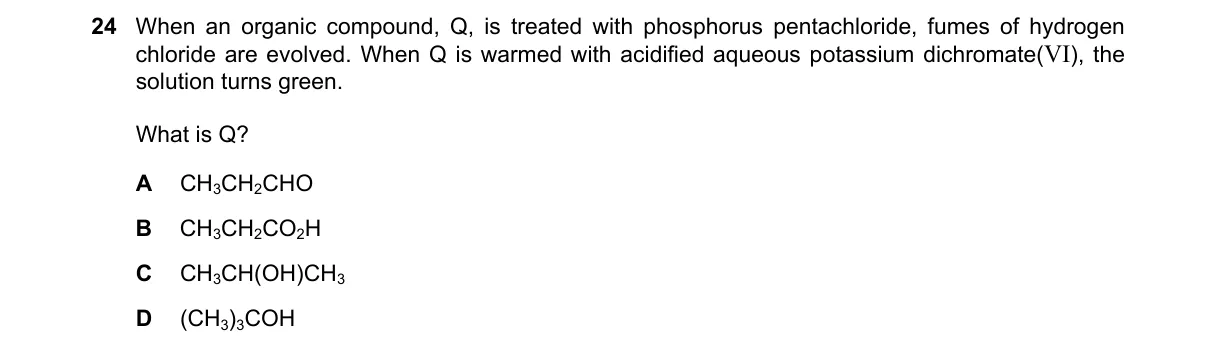
Answer choices
- ACH3CHO
- BCH3CH2OH
- CCH3COCH3
- DCH3COOH
Explanation
Compound Q has -OH group and is oxidizable to Cr³⁺ (green) Steps:
- PCl₅ treatment evolves HCl fumes, indicating labile H from -OH (alcohols) or -COOH (acids); carbonyls like aldehydes/ketones form gem-dichlorides without HCl.
- Acidified K₂Cr₂O₇ warming turns solution green (Cr⁶⁺ → Cr³⁺), confirming Q undergoes oxidation; ketones and carboxylic acids resist this.
- Eliminate A (CH₃CHO): aldehyde oxidizes (green) but no HCl with PCl₅ (RCHO + PCl₅ → RCHCl₂ + POCl₃).
- Select B (CH₃CH₂OH): primary alcohol gives HCl (ROH + PCl₅ → RCl + POCl₃ + HCl) and oxidizes to CH₃COOH (green Cr³⁺). Why B is correct:
- Ethanol reacts with PCl₅ to evolve HCl (due to -OH) and oxidizes via [O] from Cr₂O₇²⁻/H⁺ to acetate, reducing Cr⁶⁺ to green Cr³⁺ (standard alcohol oxidation test). Why the others are wrong:
- A: No HCl evolution with PCl₅, as aldehyde lacks replaceable -OH hydrogen.
- C: No reaction with PCl₅ (no HCl); ketone not oxidized, no green color.
- D: HCl with PCl₅ (from -COOH), but carboxylic acid not oxidized, no green color.
Final answer: B
Topic: Hydroxy compounds
Practice more A Levels Chemistry (9701) questions on mMCQ.me