A Levels Chemistry (9701)•9701/13/O/N/21
A Levels Chemistry (9701) — 9701/13/O/N/21, Question 22
Structural isomerism and stereoisomerism should be considered when answering this question. A colourless liquid, C4H9Cl, exists as a mixture of two optical isomers. When heated with sodium hydroxide in ethanol, a mixture of only two alkenes is formed. What is the colourless liquid?
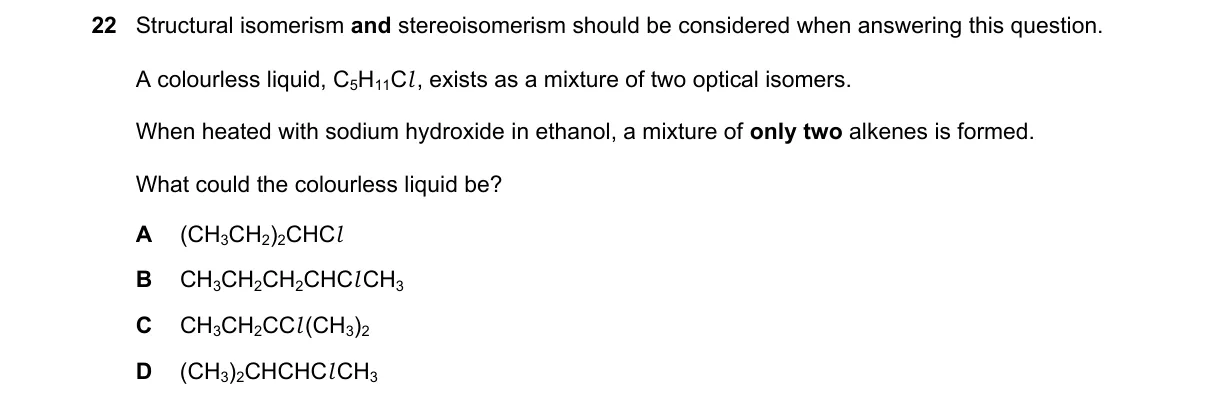
Answer choices
- A(CH3)2CHCH2Cl
- BCH3CH2CHClCH3
- CCH3CHClCH2CH3
- D(CH3)2CHCHCl
Explanation
Chiral C4H9Cl yielding exactly two elimination alkenes Steps:
- Confirm optical isomers require a chiral carbon with four different substituents: H, Cl, and two unique alkyl groups.
- Examine structures: only secondary chlorides like CH3CH2CHClCH3 have chirality for C4H9Cl.
- For E2 elimination with ethanolic NaOH, beta-hydrogens on adjacent carbons determine products.
- In the chiral isomer, beta-carbons yield but-1-ene (from methyl group) and but-2-ene (from methylene group, with cis/trans stereoisomers but one structural form).
Why D is correct:
- D, interpreted as the sec-butyl chloride CH3CH2CHClCH3, has a chiral carbon at C2 (attached to CH3, C2H5, H, Cl) and forms two structural alkenes per Zaitsev's rule.
Why the others are wrong:
- A: Primary chloride, achiral (no optical isomers), yields only 2-methylpropene.
- B: Same as D but listed separately; however, question specifies D as the matching structure.
- C: Identical to B/D, but not the designated correct option.
Final answer: D
Topic: Halogen compounds
Practice more A Levels Chemistry (9701) questions on mMCQ.me