A Levels Chemistry (9701)•9701/13/O/N/21
A Levels Chemistry (9701) — 9701/13/O/N/21, Question 16
In a series of nine experiments, to test the reactivity of the halogens, an aqueous solution of each halogen is added to an equal volume of an aqueous solution containing halide ions, as shown in the table. The nine test tubes are left to stand so that the aqueous and organic solvents separate into layers. How many test-tubes contain a purple upper hexane layer?
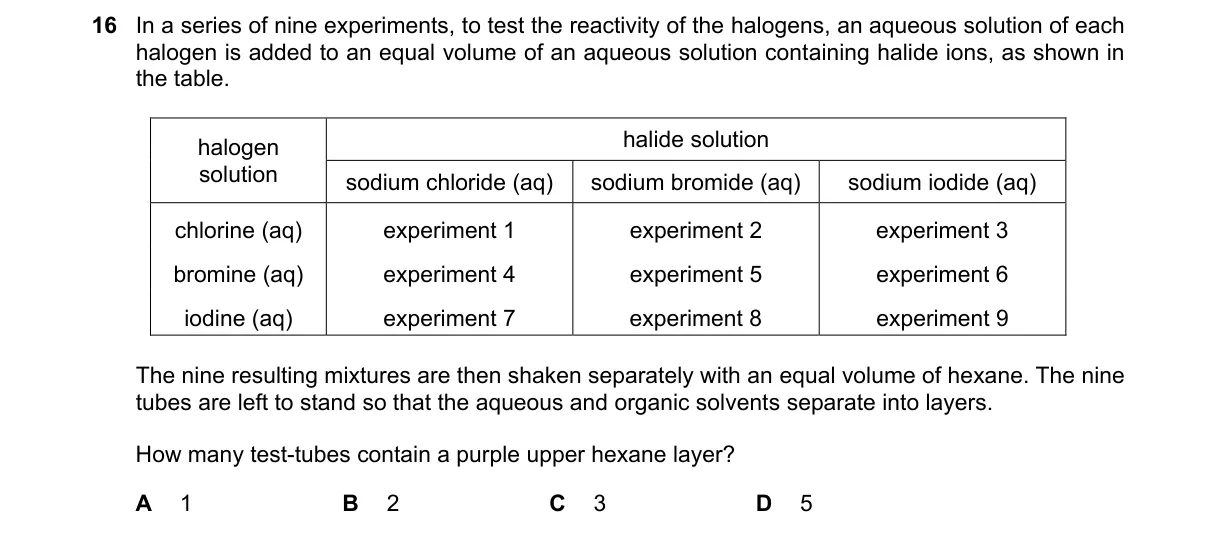
Answer choices
- A1
- B2
- C3
- D5
Explanation
Purple hexane layer from iodine presence Steps:
- Halogen reactivity: Cl₂ displaces Br⁻ and I⁻; Br₂ displaces I⁻; I₂ displaces none.
- Purple color in hexane indicates I₂ (from starting I₂ or displacement of I⁻).
- I₂ produced in: Cl₂ + I⁻ and Br₂ + I⁻ (2 cases).
- I₂ present in all three I₂ tests (with Cl⁻, Br⁻, I⁻), regardless of reaction.
- Total: 2 displacements + 3 I₂ tests = 5 purple layers.
Why D is correct:
- Five combinations yield I₂, which colors hexane purple due to its solubility and color in nonpolar solvents.
Why the others are wrong:
- A: Underestimates by ignoring I₂ tests and one displacement.
- B: Accounts for displacements but misses most I₂ tests.
- C: Includes displacements and some I₂ tests but omits one I₂ case.
Final answer: D
Topic: Group 17
Practice more A Levels Chemistry (9701) questions on mMCQ.me