A Levels Chemistry (9701) — 9701/12/O/N/21, Question 7
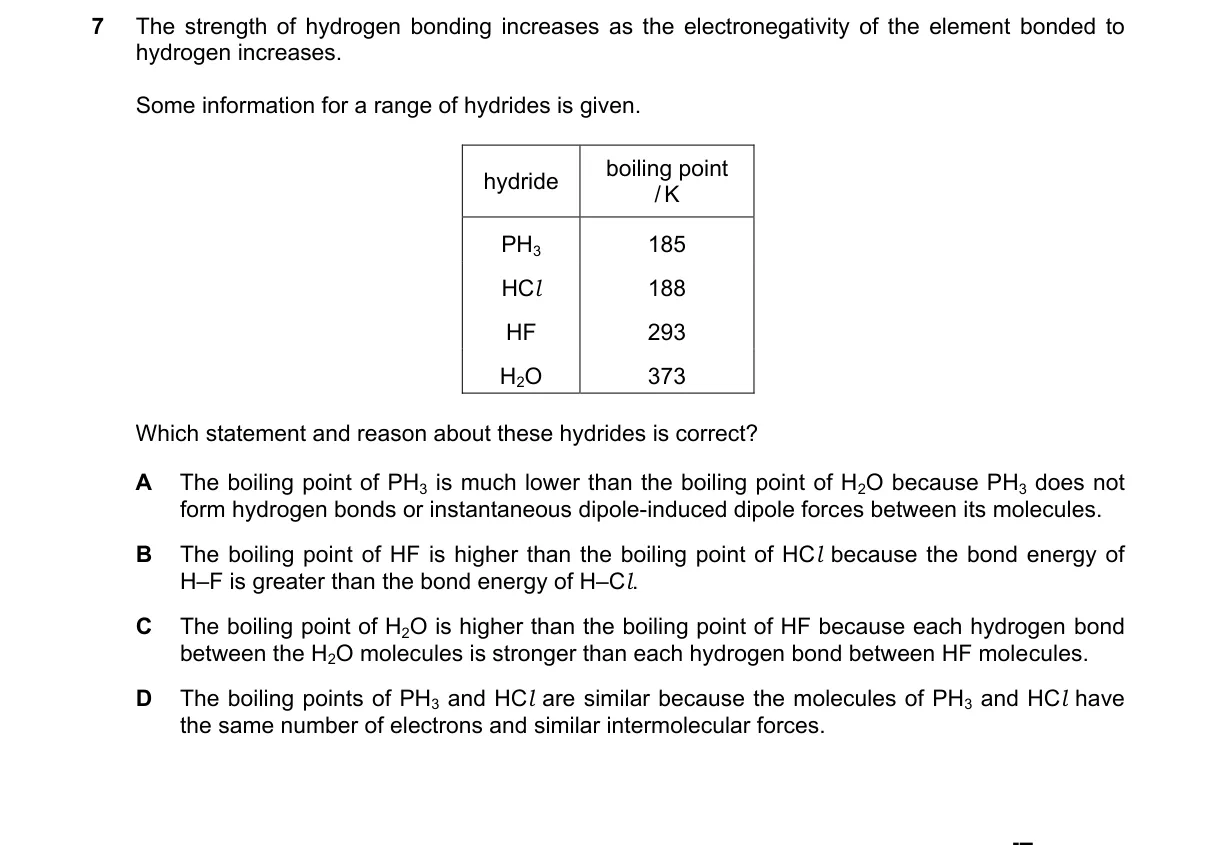
Answer choices
- AThe boiling point of PH₃ is much lower than the boiling point of H₂O because PH₃ does not form hydrogen bonds
- BThe boiling point of H₂O is higher than the boiling point of HF because the energy of hydrogen bonds in H₂O is greater than in HF
- CThe boiling point of H₂O is higher than that of HF because each hydrogen bond in H₂O is weaker than in HF
- DThe boiling points of PH₃ and HCl are similar because they have the same number of electrons and similar intermolecular forces
Explanation
Intermolecular Forces in Hydrides Steps: - Examine boiling points: PH₃ (98, likely K) lacks H-bonds, HF (189 K) has moderate H-bonds, H₂O (373 K) has strong H-bonds. - Recall H-bonding requires electronegative atoms (F, O, N); PH₃'s P is less electronegative, so no H-bonds. - Compare PH₃ and HCl: both have 18 electrons, similar molar masses, leading to comparable London dispersion and dipole-dipole forces. - Evaluate options: A explains PH₃ vs. H₂O correctly but ignores HCl; B and C miscompare H₂O vs. HF H-bond strength; D fits PH₃-HCl similarity. Why D is correct: - PH₃ and HCl each have 18 electrons, producing similar London dispersion forces (proportional to electron count and size) as primary intermolecular forces, without strong H-bonding. Why the others are wrong: - A: PH₃ vs. H₂O comparison is accurate, but question focuses on PH₃-HCl similarity, not provided. - B: H₂O's higher bp results from more H-bonds per molecule (two donors/acceptors) vs. HF's one, not stronger individual bonds. - C: Individual H-bonds in H₂O are similar or slightly weaker than in HF, but H₂O forms more extensive networks. …
Practice more A Levels Chemistry (9701) questions on mMCQ.me