A Levels Chemistry (9701)•9701/12/O/N/21
A Levels Chemistry (9701) — 9701/12/O/N/21, Question 32
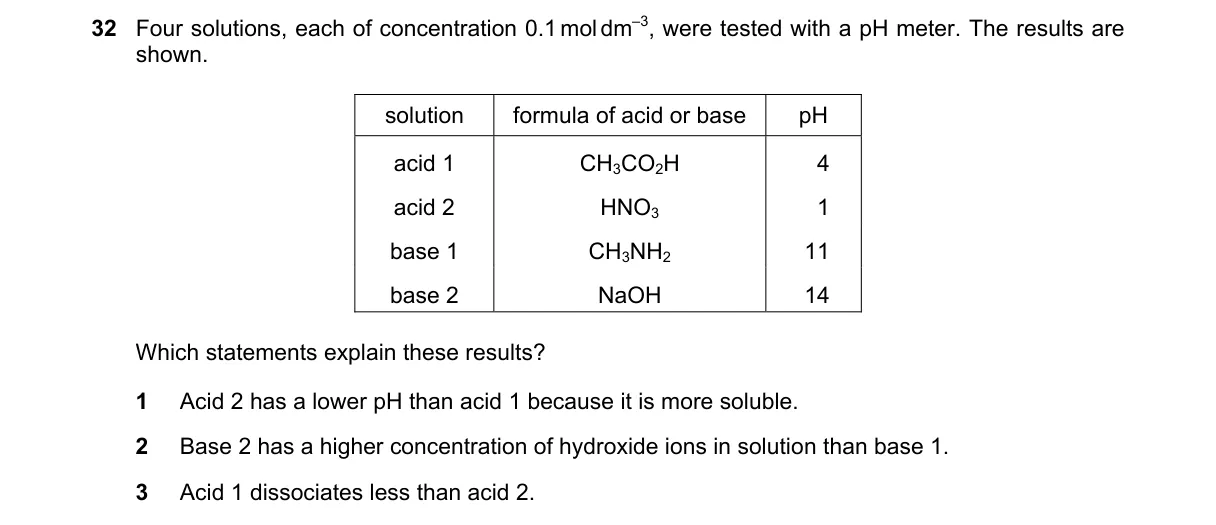
Four solutions, each of concentration 0.1M, were tested with a pH meter. The results are shown.
Solution | Formula | pH
Acid 1 | CH3COOH | 4
Base 1 | NH3 | 11
Acid 2 | HCl |
Base 2 | NaOH | 14
Which statements
Answer choices
- AAcid 1 has lower pH than acid 2 because it is more soluble than acid 2
- BBase 1 has higher concentration of hydroxide ions in solution than base 2
- CAcid 1 dissociates less than acid 2
- DBase 2 has higher concentration of hydroxide ions in solution than base 1
Explanation
Weak vs. strong acid dissociation determines pH Steps:
- Classify solutions: CH3COOH (Acid 1) is weak acid; HCl (Acid 2) is strong acid.
- Strong acids fully dissociate at 0.1 M, yielding [H+] = 0.1 M (pH = 1).
- Weak acids partially dissociate; pH = 4 for Acid 1 means [H+] = 10^{-4} M, much lower than 0.1 M.
- Lower dissociation in weak acids explains higher pH compared to strong acids.
Why C is correct:
- Weak acids dissociate less completely than strong acids, per the definition of acid strength and Ka values (e.g., Ka for CH3COOH ≈ 10^{-5}).
Why the others are wrong:
- A: pH of Acid 2 not given; not enough information to compare pH values or attribute to solubility (both acids are soluble).
- B: pH 11 (Base 1) gives [OH-] = 10^{-3} M; pH 14 (Base 2) gives higher [OH-]; Base 1 has lower [OH-].
- D: pH 14 for 0.1 M Base 2 implies [OH-] = 1 M, inconsistent with 0.1 M concentration; not enough information.
Final answer: C
Topic: Equilibria
Practice more A Levels Chemistry (9701) questions on mMCQ.me