A Levels Chemistry (9701)•9701/12/O/N/21
A Levels Chemistry (9701) — 9701/12/O/N/21, Question 29
Organic compound Z has an alcohol group and a carboxylic group. Z reacts with magnesium carbonate to make a salt with a relative formula mass of 203.3. Compound Z does not react with acidified potassium manganate(VII). What could be the identity of compound Z?
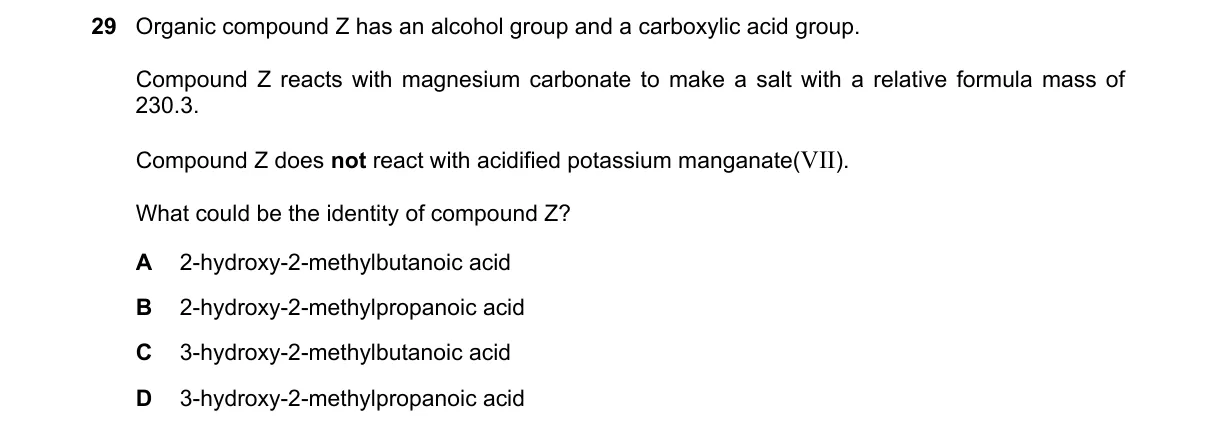
Answer choices
- A2-hydroxy-2-methylbutanoic acid
- B3-hydroxy-2-methylpropanoic acid
- C3-hydroxy-2-methylbutanoic acid
- D3-hydroxy-2-methylpropanoic acid
Explanation
Tertiary alcohol in Z prevents oxidation by acidified KMnO4
Steps:
- Acidified KMnO4 oxidizes primary alcohols to carboxylic acids and secondary alcohols to ketones, but tertiary alcohols remain unreacted.
- Identify the alcohol type in each option by examining the carbon bearing the OH group.
- Option A: C2 is attached to C1 (carboxy), CH3, CH2CH3, and OH—tertiary, no reaction.
- Options B and D: CH2OH group—primary, reacts; option C: CH(OH)CH3 group—secondary, reacts.
- The salt Mr confirms molecular size, but oxidation test identifies A as matching no reaction.
Why A is correct:
- Tertiary alcohols lack a hydrogen on the OH-bearing carbon, preventing formation of a carbonyl group per oxidation mechanism.
Why the others are wrong:
- B: Primary alcohol oxidizes, decolorizing KMnO4.
- C: Secondary alcohol oxidizes to ketone, decolorizing KMnO4.
- D: Primary alcohol oxidizes, decolorizing KMnO4.
Final answer: A
Topic: Carboxylic acids and derivatives
Practice more A Levels Chemistry (9701) questions on mMCQ.me