A Levels Chemistry (9701)•9701/12/O/N/21
A Levels Chemistry (9701) — 9701/12/O/N/21, Question 25
A haloalkane has the molecular formula C4H9Br. The haloalkane does not form an alkene when treated with ethanolic sodium hydroxide. What could be the haloalkane?
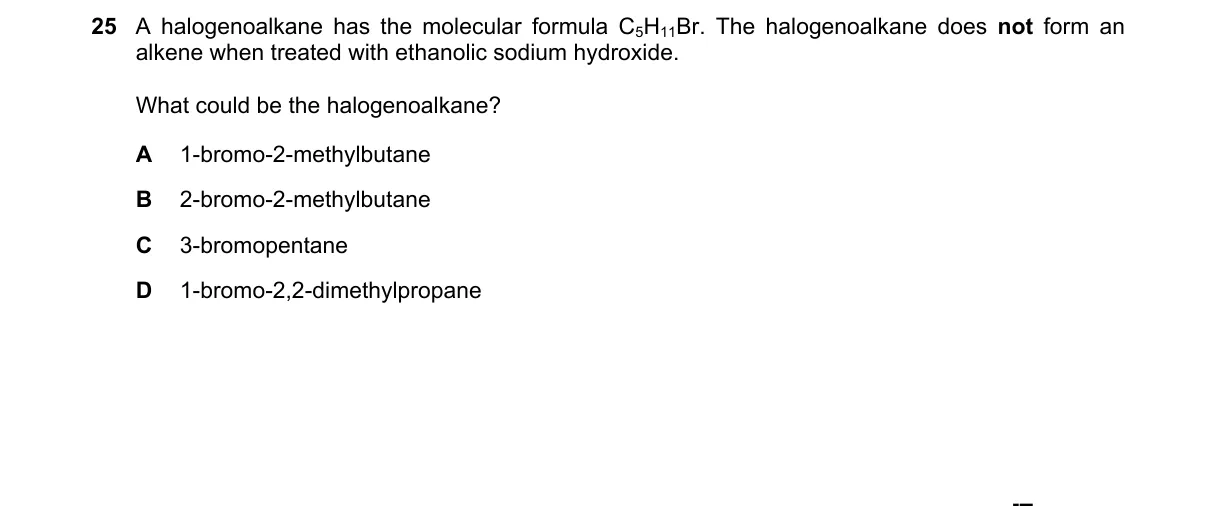
Answer choices
- A1-bromo-2-methylbutane
- B2-bromo-2-methylbutane
- C3-bromopentane
- D1-bromo-2-methylpropane
Explanation
Primary haloalkanes favor substitution over elimination with ethanolic NaOH Steps:
- Verify molecular formulas: C4H9Br requires 4 carbons; A, B, C describe C5 structures (2-methylbutane and pentane bases), yielding C5H11Br.
- Only D (1-bromo-2-methylpropane, (CH3)2CHCH2Br) matches C4H9Br.
- Classify halide types: primary halides like D undergo SN2 substitution; secondary/tertiary undergo E2 elimination to alkenes.
- Thus, D does not form an alkene, fitting the condition.
Why D is correct:
- As a primary halide (Br on CH2 group), it follows the rule that primaries resist E2 elimination, preferring SN2 with ethanolic NaOH.
Why the others are wrong:
- A: Molecular formula is C5H11Br, not C4H9Br.
- B: Molecular formula is C5H11Br; tertiary halide would undergo E2 to form alkene.
- C: Molecular formula is C5H11Br; secondary halide would undergo E2 to form alkene.
Final answer: D
Topic: Halogen compounds
Practice more A Levels Chemistry (9701) questions on mMCQ.me